English
 Español
 tiếng việt
 русский
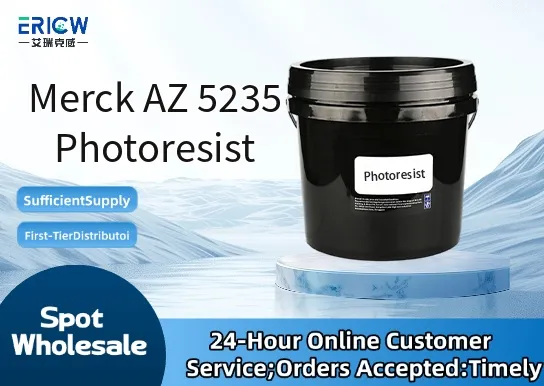
High-resolution positive-tone photoresist optimized for g-line (436 nm) and i-line (365 nm) lithography.
Excellent thermal stability and post-exposure bake (PEB) latitude for robust process control.
Superior adhesion to silicon, silicon dioxide, and metal substrates without additional primers.
Low outgassing characteristics suitable for vacuum-based patterning environments.
Consistent film-forming performance with low defect density after spin-coating and soft bake.
Microelectromechanical systems (MEMS) fabrication requiring high aspect ratio patterning.
Analog and mixed-signal IC manufacturing in 0.8–1.2 µm design rules.
Mask-making for photomasks used in semiconductor front-end processes.
Sensor device patterning, including pressure, optical, and biosensor platforms.
Research and development of novel microstructures in university and industrial cleanroom labs.
| Chemical Type | Novolac resin–based positive photoresist with diazonaphthoquinone (DNQ) sensitizer |
| Product Form | Liquid solution in propylene glycol monomethyl ether acetate (PGMEA) |
| Appearance | Clear, pale yellow liquid, free of visible particles or haze |
| Viscosity (23 °C) | ~2.5–3.0 cP (as supplied, undiluted) |
| Primary Applications | g-line and i-line photolithography for microfabrication |
| Key Features | High photospeed (~40–60 mJ/cm² at i-line), good resolution (≥0.7 µm lines/spaces), and wide process window |
| Benefits | Reduced cycle time, high reproducibility across wafer lots, and compatibility with standard developer (0.26 N TMAH) |
| Regulatory Compliance | REACH compliant; RoHS 2011/65/EU applicable; no SVHCs above threshold per current SDS |
| Common Compatible Systems | Suitability |
| Coater/Developer Track (e.g., Tokyo Electron CLEAN TRACK ACT 8) | Highly Recommended – Fully validated for dispense, spin, soft bake, develop, and rinse sequences |
| i-line Stepper (e.g., Canon FPA-3000 i-line) | Highly Recommended – Optimized exposure dose and focus settings available in Merck process guide |
| Wet Bench Development (manual or semi-automated) | Recommended – Requires precise temperature (23 ± 0.5 °C) and agitation control for uniformity |
| UV Cure & Hard Bake Ovens (e.g., BTU Pyramax) | Suitable – Compatible with post-develop hard bake up to 140 °C for enhanced etch resistance |
Q1: What is the CAS Registry Number for AZ 5235 Photoresist?
A: AZ 5235 is a proprietary formulation; individual components have CAS numbers (e.g., DNQ sensitizer: 2493-34-1; novolac resin: variable), but the final product is not assigned a single CAS number per regulatory convention for multicomponent commercial photoresists.
Q2: What is the typical coating thickness and recommended spin speed range?
A: At 3000–4000 rpm on 100 mm wafers, achieves 1.2–1.8 µm dry film thickness; optimal spin speed depends on substrate size, desired thickness, and equipment calibration—refer to Merck’s Process Integration Guide for wafer-specific protocols.
Q3: How does AZ 5235 compare to AZ 5214E in terms of resolution and etch resistance?
A: AZ 5235 offers higher resolution (≤0.7 µm vs. ~1.0 µm for AZ 5214E) and improved plasma etch resistance due to optimized resin crosslinking, while AZ 5214E provides superior lift-off capability—selection depends on process priority: patterning fidelity (AZ 5235) vs. metal lift-off (AZ 5214E).
Q4: Is AZ 5235 compliant with FDA or USP standards for use in medical device manufacturing?
A: AZ 5235 is not certified to FDA 21 CFR or USP <87>/<88> for direct biocompatibility testing; it is intended for microfabrication where residual resist is fully removed prior to device release—end-product biocompatibility must be validated separately per ISO 10993.
Q5: Are there known extractables or leachables from AZ 5235 under standard processing conditions?
A: No significant extractables are observed when processed per Merck’s recommended parameters (full development, rinse, and hard bake); residual solvent and low-MW fractions are effectively removed—GC-MS analysis per ICH Q5 shows <1 ppm volatile organics in final patterned films.
Contact With Us:
E-mail: wangxingqiang@ericwchem.com
Have a Questions? Call Us:
Add:
Building A1, Jiete Industrial Park, Huangpu District, Guangzhou City, Guangdong Province, China