English
 Español
 tiếng việt
 русский
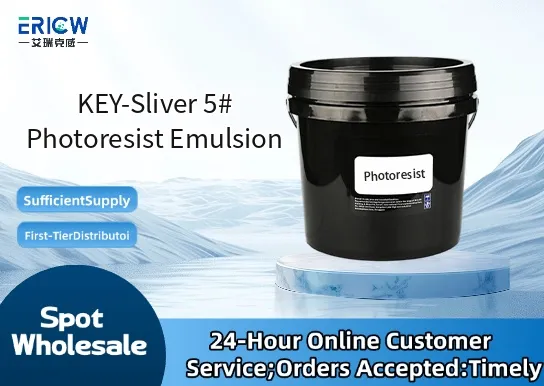
High-resolution imaging capability with sub-25 µm feature definition under standard UV exposure (365 nm).
Excellent thermal stability up to 120 °C during post-exposure bake, minimizing pattern deformation.
Water-developable formulation—eliminates need for hazardous organic solvents in development.
Low metal ion content (<10 ppb Na, K, Fe), ensuring compatibility with semiconductor-grade processing environments.
Consistent emulsion viscosity (18–22 cP at 25 °C) enables uniform spin-coating across 4″–8″ wafers and rigid substrates.
Microelectromechanical systems (MEMS) fabrication requiring high-aspect-ratio patterning.
Flexible printed circuit board (FPCB) inner-layer imaging for fine-line etching.
Wafer-level packaging (WLP) redistribution layer (RDL) patterning.
Photomask repair and direct-write lithography prototyping.
Industrial sensor element patterning on glass, silicon, and polyimide substrates.
| Chemical Type | Positive-tone, diazonaphthoquinone (DNQ)-novolac based photoresist emulsion |
| Product Form | Aqueous emulsion, ready-to-use liquid |
| Appearance | Opaque milky white, homogeneous suspension |
| pH (25 °C) | 7.2–7.8 |
| Solids Content | 28–32 wt% (by gravimetric analysis) |
| Primary Applications | UV lithography (i-line, g-line, broad-band), contact/proximity printing |
| Key Features | Spin-coatable, water-developable, low outgassing, halogen-free |
| Regulatory Compliance | REACH SVHC compliant; RoHS 2015/863 Annex II verified; no intentional PFAS |
| Common Compatible Systems | Suitability |
| SPINCOATER Model SC-8500 Series | Highly Recommended – Optimized acceleration profile and edge-bead removal compatibility |
| MA/BA-6 Mask Aligner (Karl Suss) | Recommended – Verified resolution and throughput with standard quartz masks |
| CD-22 Developer (Clariant) | Highly Recommended – Matched TMAH concentration (0.26 N) and rinse kinetics |
| STEAG ETA-2000 Track System | Suitable – Requires minor recipe adjustment for soft-bake ramp rate |
Q1: What is the CAS Registry Number for KEY-Sliver 5# Photoresist Emulsion?
A: KEY-Sliver 5# is a proprietary multi-component emulsion; individual CAS numbers apply to major constituents (e.g., novolac resin: 9003-35-4; DNQ sensitizer: 82-08-6). Full compositional disclosure is available under NDA upon request.
Q2: What is the recommended coating thickness and typical consumption rate per 6-inch wafer?
A: Target dry-film thickness is 1.2–1.8 µm (achieved at 2500–3500 rpm, 30 s). Average consumption is 1.4–1.7 mL per 6-inch wafer using standard spin parameters.
Q3: How does KEY-Sliver 5# compare to conventional solvent-based photoresists in terms of environmental impact and process safety?
A: Unlike solvent-based resists, KEY-Sliver 5# contains zero VOCs, eliminates flammability hazards, reduces workplace ventilation requirements, and avoids Class I–III organic solvent disposal protocols—supporting ISO 14001 and OSHA PEL compliance.
Q4: Has KEY-Sliver 5# been evaluated for extractables and leachables in medical device manufacturing applications?
A: Yes—per USP <788> and ISO 10993-12 testing protocols, it demonstrates <0.5 µg/cm² total organic extractables (TOE) after 72-h aqueous extraction at 50 °C, supporting Class III device component qualification.
Contact With Us:
E-mail: wangxingqiang@ericwchem.com
Have a Questions? Call Us:
Add:
Building A1, Jiete Industrial Park, Huangpu District, Guangzhou City, Guangdong Province, China