English
 Español
 tiếng việt
 русский
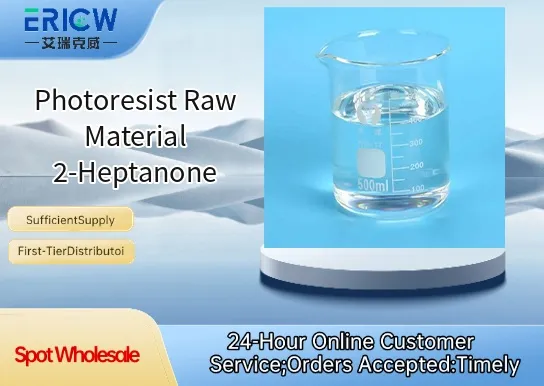
High-purity grade specifically refined for semiconductor-grade photoresist formulation.
Low water content (<50 ppm) to minimize hydrolysis risk in acid-sensitive resist systems.
Controlled volatility (bp 151 °C) enabling precise solvent balance and film uniformity during spin-coating.
Exceptional chemical stability under inert storage conditions, ensuring consistent performance across production batches.
Ultra-low trace metal impurities (≤10 ppb each of Fe, Cu, Na, K) meeting SEMI C12 purity standards.
Primary solvent component in positive-tone chemically amplified resists (CARs) for advanced lithography (i-line, KrF, ArF).
Co-solvent in multi-component resist blends to adjust viscosity, evaporation rate, and substrate wetting behavior.
Carrier medium for photoacid generators (PAGs) and polymer resins during resist stock solution preparation.
Cleaning agent for photomask and wafer handling tools where residue-free volatility is critical.
Process intermediate in the synthesis of functionalized ketone derivatives used as resist additives.
| Chemical Type | Methyl n-amyl ketone (C7H14O), aliphatic methyl ketone |
| Product Form | Liquid at room temperature |
| Appearance | Clear, colorless liquid with characteristic ketonic odor |
| Melting Point | −48 °C |
| Boiling Point | 151 °C (at 760 mmHg) |
| Density (20 °C) | 0.813–0.817 g/cm³ |
| Water Content | ≤50 ppm (by Karl Fischer titration) |
| Residue on Evaporation | ≤10 ppm |
| Common Compatible Systems | Suitability |
| Poly(hydroxystyrene)-based CAR formulations | Highly Recommended – Excellent solubility and controlled evaporation profile |
| Acrylate-based negative-tone resists | Recommended – Effective co-solvent when blended with PGMEA or cyclohexanone |
| Spin-coating track solvent delivery modules (e.g., Tokyo Electron CLEAN TRACK) | Highly Recommended – Low particulate generation and high compatibility with stainless-steel/PTFE fluid paths |
| Photoacid generator (PAG) dissolution systems (e.g., triarylsulfonium salts) | Suitable – Stable dispersion without premature decomposition under ambient conditions |
Q1: What is the CAS Number for 2-Heptanone?
A: The CAS Registry Number for 2-Heptanone is 110-43-0.
Q2: What is the typical recommended usage concentration in photoresist formulations?
A: 2-Heptanone is typically used at 15–40 wt% in final resist solutions, depending on resin molecular weight and target coating thickness; optimization via rheology and drying studies is advised.
Q3: How does 2-Heptanone compare to PGMEA in photoresist applications?
A: Unlike PGMEA (lower boiling point, higher polarity), 2-Heptanone offers slower evaporation kinetics and lower hydrogen-bonding capacity—enabling improved edge bead removal control and reduced interfacial stress in thick-film resists.
Q4: Is this material compliant with REACH and RoHS regulations?
A: Yes—this grade is fully REACH registered (EC No. 203-769-9) and RoHS-compliant; SDS and regulatory documentation are available upon request.
Q5: Does 2-Heptanone exhibit migration or extractable residues in post-developed wafers?
A: When processed per standard bake and develop protocols, residual 2-Heptanone levels fall below 1 ppm (detection limit by GC-MS), with no observed impact on device leakage current or interface trap density.
Contact With Us:
E-mail: wangxingqiang@ericwchem.com
Have a Questions? Call Us:
Add:
Building A1, Jiete Industrial Park, Huangpu District, Guangzhou City, Guangdong Province, China