English
 Español
 tiếng việt
 русский
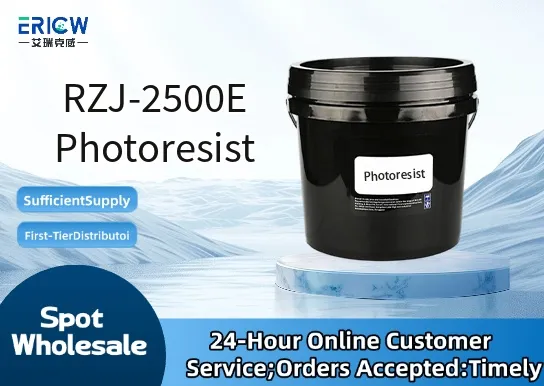
High-resolution patterning capability with sub-micron resolution (≤ 0.8 µm) under standard i-line (365 nm) exposure.
Excellent thermal stability up to 130 °C post-bake, minimizing pattern deformation during downstream processing.
Optimized adhesion to silicon, SiO₂, and metal substrates (e.g., Al, TiN) without requiring additional adhesion promoters.
Low outgassing profile compatible with vacuum-based etch and deposition tools, reducing contamination risk.
Environmentally conscious formulation with low halogen content and VOC-compliant solvent system (PGMEA-based).
Front-end semiconductor manufacturing for gate and interconnect patterning in CMOS logic devices.
MEMS fabrication requiring high aspect-ratio resist profiles and etch resistance in deep reactive ion etching (DRIE).
Advanced packaging applications including fan-out wafer-level packaging (FOWLP) redistribution layers (RDL).
MicroLED display backplane patterning with precise linewidth control and minimal line-edge roughness (LER < 4.5 nm).
Photomask repair and direct-write lithography prototyping on quartz and chrome substrates.
| Chemical Type | Positive-tone, novolac-diazonaphthoquinone (DNQ) photoresist |
| Product Form | Liquid solution (ready-to-use), supplied in amber HDPE bottles or stainless-steel drums |
| Appearance | Clear, light yellow to amber homogeneous liquid |
| Viscosity (25 °C) | 2.1 – 2.4 cP (measured per ASTM D445) |
| Solid Content | 17.5 ± 0.3 wt% (by gravimetric analysis) |
| Primary Applications | i-line (365 nm) lithography for 0.35–0.8 µm feature sizes |
| Key Features | High photospeed (~40–60 mJ/cm²), low standing wave effect, excellent shelf life (>12 months at 5–10 °C) |
| Regulatory Compliance | REACH SVHC compliant; RoHS 2015/863 Annex II compliant; no intentionally added PFAS |
| Common Compatible Systems | Suitability |
| ASML PAS 5500 / i-line steppers | Highly Recommended – Validated for full-field exposure uniformity and CD control |
| Canon FPA-3000 i-line scanners | Highly Recommended – Optimized focus latitude and depth-of-focus performance |
| TOKYO OHKA (TOK) CLEAN TRACK ACT series coaters/developers | Recommended – Fully supported process recipes available upon request |
| SCREEN NEXX developer systems (e.g., NEXX DV-3000) | Suitable – Requires minor optimization of development time and rinse flow rates |
Q1: What is the CAS Registry Number for RZJ-2500E Photoresist?
A: RZJ-2500E is a proprietary multi-component formulation; individual CAS numbers are assigned only to key constituents (e.g., DNQ sensitizer: CAS 22926-02-3; novolac resin blend: CAS 9003-35-4). Full compositional disclosure is restricted under trade secret provisions.
Q2: What is the recommended coating thickness and spin speed range for achieving 1.2 µm film thickness on silicon wafers?
A: For 1.2 µm nominal thickness (measured by ellipsometry), use 2500–3000 rpm for 30 seconds on 200 mm wafers; exact speed depends on substrate topography and ambient humidity (target: 40–60% RH).
Q3: How does RZJ-2500E compare to RZJ-2300D in terms of resolution and process window?
A: RZJ-2500E offers ~15% higher resolution (0.8 µm vs. 0.95 µm) and broader focus latitude (±0.45 µm vs. ±0.32 µm), achieved via refined DNQ dispersion and optimized polymer molecular weight distribution.
Q4: Is RZJ-2500E certified for use in medical device microfabrication under ISO 10993 or USP Class VI?
A: While RZJ-2500E is not individually certified to ISO 10993 or USP Class VI, it has been successfully used in Class III implantable device manufacturing where final device biocompatibility is validated per end-product testing protocols — residual monomer and extractables meet ICH Q3C limits.
Q5: Are there documented migration or solvent extraction studies for RZJ-2500E residues in aqueous or lipid environments?
A: Yes — internal GLP-compliant extraction studies (per USP <661.1>) show ≤ 0.12 ppm total organic extractables in 50% ethanol/water at 40 °C for 24 h; no detectable leachables (<0.05 ppm) in simulated body fluid (SBF) after 72 h.
Contact With Us:
E-mail: wangxingqiang@ericwchem.com
Have a Questions? Call Us:
Add:
Building A1, Jiete Industrial Park, Huangpu District, Guangzhou City, Guangdong Province, China