English
 Español
 tiếng việt
 русский
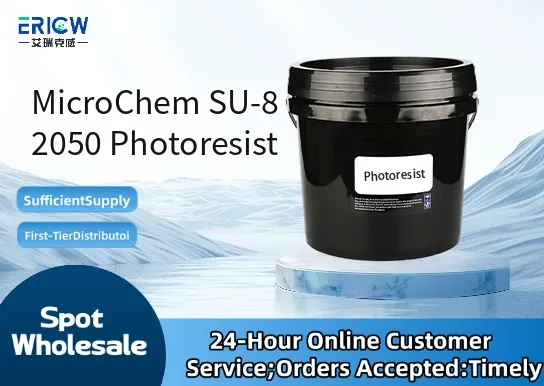
High-resolution negative-tone photoresist with sub-micron lithographic capability (down to 0.5 µm line/space).
Excellent thermal stability and chemical resistance after post-exposure bake (up to 200 °C).
Low outgassing and high optical transparency in UV–DUV range, ideal for mask aligners and stepper systems.
Deep UV (365 nm) sensitivity with high photospeed and wide process latitude (exposure dose: 15–45 mJ/cm²).
Single-layer processing without need for anti-reflective coatings on silicon, glass, or metal substrates.
Microelectromechanical systems (MEMS) fabrication including accelerometers, gyroscopes, and pressure sensors.
Microfluidic device patterning for lab-on-a-chip platforms and biomedical diagnostics.
High-aspect-ratio microstructures for micro-optics, diffractive optical elements (DOEs), and photonic integrated circuits.
Wafer-level packaging and redistribution layer (RDL) processing in advanced semiconductor packaging.
3D microfabrication via grayscale lithography and multi-layer stacking for complex topographies.
| Chemical Type | Epoxy-based negative-tone photoresist (bisphenol A novolac epoxy resin with photoinitiator) |
| Product Form | Viscous amber liquid, supplied in sealed amber HDPE bottles (100 mL, 500 mL, and 1 L) |
| Appearance | Clear to slightly amber, homogeneous solution (no sediment or haze) |
| Viscosity (25 °C) | 2050 ± 200 cP (measured per ASTM D2196) |
| Primary Applications | Negative-tone lithography for MEMS, microfluidics, optics, and packaging |
| Key Features | High resolution, deep UV sensitivity, excellent adhesion, low shrinkage (< 1.5% after PEB) |
| Benefits | Reduced process steps, compatibility with standard cleanroom tools, high yield in thick-film applications (up to 200 µm) |
| Regulatory Compliance | RoHS 2015/863/EU compliant; REACH SVHC-free (per latest MicroChem declaration) |
| Common Compatible Systems | Suitability |
| Karl Suss MA6 / MJB4 Mask Aligner | Highly Recommended – Optimized exposure parameters and alignment accuracy verified |
| Canon PLA-500F Stepper | Recommended – Requires minor focus and dose calibration for 365 nm i-line |
| SVGL MicraStep i-line Scanner | Suitable – Validated for full-wafer exposure at 365 nm with standard reticles |
| Headway EC300 Spin Coater | Highly Recommended – Pre-programmed recipes available for uniform 5–200 µm films |
| BTU Pyramax 4000 Hot Plate | Highly Recommended – Precise soft-bake and post-exposure bake profiles validated |
Q1: What is the CAS Registry Number for SU-8 2050?
A: The CAS number for MicroChem SU-8 2050 Photoresist is 174255-52-0 (as assigned to the proprietary epoxy resin formulation; individual components have separate CAS numbers).
Q2: How much SU-8 2050 is typically consumed per 100 mm wafer at 50 µm thickness?
A: Approximately 1.2–1.5 mL per 100 mm wafer (based on spin speed of 1,000 rpm and 60 s duration); consumption scales linearly with film thickness and substrate area.
Q3: How does SU-8 2050 differ from SU-8 2075 in terms of resolution and process window?
A: SU-8 2050 offers higher resolution (≤0.5 µm) and narrower process latitude vs. SU-8 2075, which prioritizes thicker-film uniformity (>100 µm) and wider exposure/dose tolerance — 2050 is optimized for fine-feature MEMS, while 2075 targets structural microfabrication.
Q4: Is SU-8 2050 compliant with ISO 10993 or USP Class VI for biomedical device fabrication?
A: SU-8 2050 is not certified to ISO 10993 or USP Class VI. For implantable or direct-tissue-contact applications, users must perform full biocompatibility validation per their regulatory pathway; MicroChem provides extractables data upon request under NDA.
Q5: Are there known leachables or migration concerns when SU-8 2050 is used in microfluidic channels contacting aqueous biological samples?
A: Unbaked or incompletely crosslinked SU-8 may release trace photoinitiator (triphenylsulfonium salt) and oligomers. Full crosslinking (≥1 min @ 200 °C PEB) reduces extractables to <10 ppb in PBS (per LC-MS/MS testing); recommended to pre-rinse devices with ethanol/water before use.
Contact With Us:
E-mail: wangxingqiang@ericwchem.com
Have a Questions? Call Us:
Add:
Building A1, Jiete Industrial Park, Huangpu District, Guangzhou City, Guangdong Province, China