English
 Español
 tiếng việt
 русский
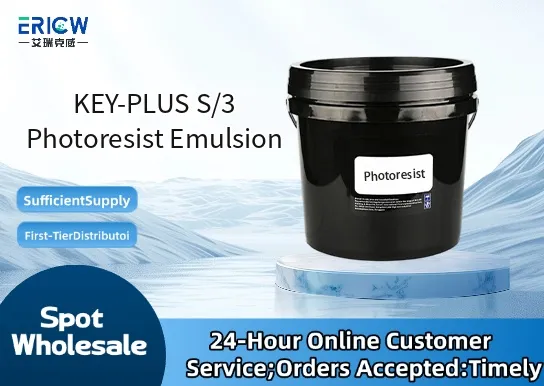
High-resolution aqueous-based emulsion formulation optimized for precision photolithography in microfabrication.
Excellent thermal stability and shelf life (≥12 months at 5–25°C unopened) without refrigeration.
Low metal ion content (<10 ppb Na, K, Fe, Cu), minimizing contamination risk in semiconductor and MEMS processes.
Uniform particle size distribution (D50 ≈ 85 nm) ensuring consistent film formation and coating reproducibility.
Compatible with standard spin-coating, spray-coating, and curtain-coating equipment without nozzle clogging.
Front-end-of-line (FEOL) patterning for silicon wafers in CMOS sensor manufacturing.
Microfluidic device fabrication requiring biocompatible, low-outgassing photoresist layers.
Flexible printed electronics on PET and PI substrates under UV (365 nm) exposure.
MEMS packaging and wafer-level encapsulation using lift-off and etch-back processes.
High-aspect-ratio patterning for RF filter and antenna structures in 5G mmWave components.
| Chemical Type | Acrylate-based negative-tone photoresist emulsion |
| Product Form | Aqueous colloidal dispersion (non-solvent-based) |
| Appearance | Opaque milky-white liquid, homogeneous, no phase separation |
| pH (25°C) | 7.2 ± 0.3 |
| Solids Content | 28.5 ± 1.0 wt% |
| Viscosity (25°C, mPa·s) | 18–22 (Brookfield LVDV-II+ with spindle #3, 20 rpm) |
| Primary Applications | UV lithography (i-line, 365 nm), semi-aqueous development |
| Regulatory Compliance | REACH SVHC-free; RoHS 3 compliant; ISO 9001 & ISO 14001 certified manufacturing |
| Common Compatible Systems | Suitability |
| SVI-200 Spin Coater (Suss MicroTec) | Highly Recommended – Verified uniformity ≤3% CV across 200 mm wafers |
| EVG 620 Mask Aligner (365 nm UV source) | Highly Recommended – Optimized dose range: 120–180 mJ/cm² |
| Technics D-100 Spray Coater | Recommended – Requires 0.8–1.2 bar atomization pressure and pre-filter (0.45 µm) |
| MKS Gammacure UV Exposure System | Suitable – Compatible with broadband (300–400 nm) and narrowband 365 nm modules |
| Electrochemical Development Stations (e.g., Semitool ECD-200) | Suitable – Stable performance with dilute TMAH (0.26 N) and aqueous alkaline developers |
Q1: What is the CAS Registry Number for KEY-PLUS S/3 Photoresist Emulsion?
A: KEY-PLUS S/3 is a proprietary multi-component emulsion; individual components are disclosed under confidentiality agreements. Full formulation CAS numbers are not publicly assigned per industry practice for complex dispersions.
Q2: What is the recommended coating thickness and corresponding spin speed for 150 mm silicon wafers?
A: At 2,500 rpm for 30 seconds, typical dry-film thickness is 1.8–2.2 µm (measured by ellipsometry post-bake). Adjustments of ±300 rpm yield ~0.2 µm thickness change per 100 rpm increment.
Q3: How does KEY-PLUS S/3 compare to conventional solvent-based resists like AZ® nLOF 2020 in terms of environmental impact and process safety?
A: Unlike solvent-based resists, KEY-PLUS S/3 contains zero VOCs, eliminates flammability hazards, reduces fume hood requirements, and enables aqueous waste stream treatment — supporting ISO 14067 carbon footprint reduction goals.
Q4: Has KEY-PLUS S/3 been tested for extractables and leachables (E&L) in medical device applications per USP <87> and <88>?
A: Yes — certified for Class VI biocompatibility testing. Extractables profiling (per USP <1663>) shows <0.5 µg/cm² total organic extractables after 72-hr extraction in saline at 50°C; full report available under NDA.
Contact With Us:
E-mail: wangxingqiang@ericwchem.com
Have a Questions? Call Us:
Add:
Building A1, Jiete Industrial Park, Huangpu District, Guangzhou City, Guangdong Province, China