English
 Español
 tiếng việt
 русский
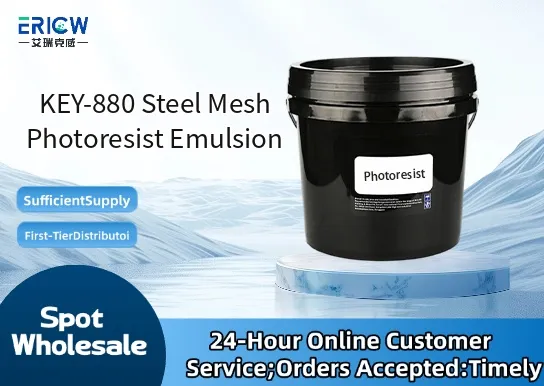
High-resolution imaging capability for fine-line steel mesh screens (down to 45–60 µm line width).
Excellent adhesion and film integrity on stainless steel, nickel, and brass mesh substrates.
Fast UV crosslinking with standard medium-pressure mercury vapor lamps (365 nm dominant peak).
Low viscosity emulsion enables uniform coating via dip, spray, or curtain coating methods.
Water-developable formulation reduces VOC emissions and simplifies post-exposure processing.
Production of high-precision filtration screens for pharmaceutical and biotech sterile processing.
Manufacturing of sputtering shadow masks used in thin-film electronics and display fabrication.
Printing screen preparation for conductive paste deposition in thick-film circuit manufacturing.
Micro-perforated components in aerospace fluid control systems requiring consistent aperture geometry.
Stencils for precision solder paste application in advanced SMT assembly of miniaturized PCBs.
| Chemical Type | Acrylated epoxy resin-based aqueous emulsion |
| Product Form | Liquid emulsion (non-aerosol, ready-to-use) |
| Appearance | Opaque off-white to light beige liquid, homogeneous without phase separation |
| Viscosity (25°C, Brookfield LVT, Spindle #3, 60 rpm) | 1,800–2,200 cP |
| pH (25°C) | 7.2–7.8 |
| Solids Content (wt%) | 32–35% |
| Primary Applications | Photoimaging on metal mesh substrates (stainless steel, nickel, brass) |
| Regulatory Compliance | REACH SVHC-free; RoHS 2015/863 compliant; no intentionally added PFAS |
| Common Compatible Systems | Suitability |
| UV Exposure Units (e.g., OAI Model 300, ABM EX-1000) | Highly Recommended – Optimized spectral match for 365 nm primary emission |
| Automatic Dip Coaters (e.g., Meyer & Busch MBC-2000) | Highly Recommended – Stable rheology ensures uniform 8–12 µm dry film thickness |
| Water-Based Spray Systems (e.g., Nordson ASI AquaJet) | Recommended – Requires dilution with deionized water (≤5% v/v) for nozzle compatibility |
| Standard Film Developers (e.g., KTI KODAK Developer Unit) | Suitable – Compatible with ambient-temperature, low-pressure aqueous development (0.5–1.0 bar) |
Q1: What is the CAS Registry Number for KEY-880?
A: KEY-880 is a proprietary multi-component emulsion; it does not have a single CAS number. Individual major constituents are documented in the full Safety Data Sheet (SDS Section 3), available upon request with NDA.
Q2: What is the typical dry-film thickness and corresponding coverage rate per liter?
A: At 10 µm dry thickness, coverage is approximately 8–10 m² per liter (depending on mesh count and tension). Recommended wet-film thickness is 25–35 µm prior to drying and exposure.
Q3: How does KEY-880 compare to solvent-based photoresists in terms of resolution and environmental impact?
A: KEY-880 achieves comparable resolution (±2 µm dimensional stability) to leading solvent-based alternatives while eliminating >95% of VOCs and enabling aqueous development—reducing hazardous waste generation and operator exposure risk.
Q4: Is KEY-880 suitable for applications requiring FDA-compliant leachables testing (e.g., pharmaceutical contact surfaces)?
A: KEY-880 is not FDA-cleared for direct food or drug contact. However, it meets USP <87> and <88> cytotoxicity requirements for Class VI plastics when fully cured and post-baked (120°C × 30 min), supporting use in non-contact cleanroom tooling and filtration hardware.
Contact With Us:
E-mail: wangxingqiang@ericwchem.com
Have a Questions? Call Us:
Add:
Building A1, Jiete Industrial Park, Huangpu District, Guangzhou City, Guangdong Province, China