English
 Español
 tiếng việt
 русский
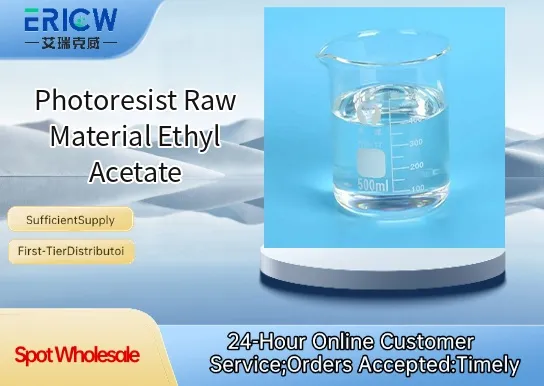
High-purity grade specifically refined for photoresist formulation—meets semiconductor-grade solvent specifications (≥99.9% assay).
Low residual water content (<50 ppm) to prevent hydrolysis of acid-labile photoactive compounds in chemically amplified resists.
Controlled trace metal impurities (Na, K, Fe, Cu <10 ppb each) to minimize defects and pattern collapse during lithography.
Consistent low-boiling point (77.1 °C) and rapid evaporation kinetics enabling precise spin-coating film uniformity.
Non-reactive with common photoacid generators (PAGs), polymers (e.g., PHS, acrylates), and dissolution inhibitors used in advanced resist platforms.
Primary solvent in positive-tone and negative-tone photoresist formulations for semiconductor front-end manufacturing (28 nm to 5 nm nodes).
Diluent and viscosity adjuster in resist coating solutions for wafer-level photolithography processes.
Component in resist removers and post-etch residue cleaners compatible with aluminum, copper, and low-k dielectric layers.
Carrier solvent for photoactive compound (PAC) dispersion in g-line and i-line resist systems.
Blending agent with propylene glycol monomethyl ether acetate (PGMEA) to fine-tune drying rate and film morphology.
| Chemical Type | Ester solvent, organic volatile compound |
| Product Form | Clear, colorless liquid |
| Appearance | Transparent, free from suspended matter or haze |
| Assay (GC) | ≥99.90% (w/w) |
| Water Content (Karl Fischer) | ≤50 ppm |
| Residue on Evaporation | ≤10 ppm |
| Trace Metals (ICP-MS) | Na, K, Fe, Cu, Ni, Cr, Zn <10 ppb each |
| Regulatory Compliance | REACH registered; RoHS compliant; non-REACH SVHC candidate |
| Common Compatible Systems | Suitability |
| Standard i-line / g-line resist formulations (e.g., novolac–DNQ) | Highly Recommended – Excellent solubility and film-forming performance |
| Chemically amplified resists (CARs) based on PHS and acrylate copolymers | Highly Recommended – Minimal interaction with PAGs and thermal acid generators |
| PGMEA-based resist blends (e.g., 70/30 PGMEA/EtOAc) | Recommended – Improves volatility profile without phase separation |
| Photoresist strip solutions containing amine-based additives | Suitable – Stable under alkaline conditions at room temperature |
Q1: What is the CAS Number for ethyl acetate used in photoresist applications?
A: The CAS Number is 141-78-6. Our photoresist-grade material is identical in identity but distinguished by ultra-low ionic and metallic impurity profiles per SEMI C37 standard.
Q2: What is the typical usage concentration in photoresist formulations?
A: Typically 70–95 wt% of the total solvent blend, depending on polymer molecular weight, solids content (10–25%), and desired spin-coating rheology.
Q3: How does photoresist-grade ethyl acetate differ from technical or food-grade material?
A: It undergoes additional fractional distillation, molecular sieve drying, and sub-micron filtration to achieve ≤10 ppb metals and ≤50 ppm water—critical to avoid micro-defects and CD variation in sub-100 nm patterning.
Q4: Is there risk of extractable migration into underlying dielectric layers during soft bake?
A: No significant migration occurs—ethyl acetate fully volatilizes below 100 °C with negligible residual solvent (<0.1%) after standard 90 °C/60 s soft bake, as verified by FTIR and GC-MS analysis.
Q5: Does this material comply with semiconductor industry environmental and safety standards?
A: Yes—it meets SEMI S2-0219 (safety guideline), SEMI F57-0701 (cleanliness), and is supplied with full SDS, TDS, and certificate of conformance (CoC) including batch-specific ICP-MS and GC data.
Contact With Us:
E-mail: wangxingqiang@ericwchem.com
Have a Questions? Call Us:
Add:
Building A1, Jiete Industrial Park, Huangpu District, Guangzhou City, Guangdong Province, China