English
 Español
 tiếng việt
 русский
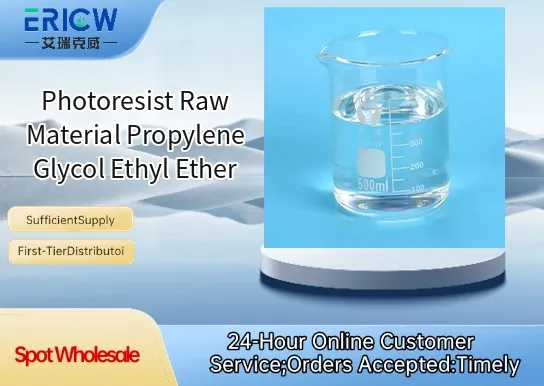
High solvency power for photoacid generators (PAGs) and resin binders in positive-tone and chemically amplified resists.
Low volatility and favorable evaporation rate—enables uniform film formation and minimizes coating defects during spin-coating.
Excellent water miscibility and compatibility with common resist solvents (e.g., PGMEA, ethyl lactate), supporting robust formulation flexibility.
Ultra-low ionic impurities (<0.1 ppm Na⁺, K⁺, Cl⁻), critical for preventing pattern collapse and metal contamination in advanced lithography.
Consistent batch-to-batch purity (>99.9% GC assay) verified via rigorous QC testing per SEMI S2/S8 standards.
Primary solvent in g-line, i-line, and KrF (248 nm) photolithography resists for semiconductor front-end manufacturing.
Co-solvent component in advanced EUV (13.5 nm) resist formulations to modulate dissolution kinetics and interfacial adhesion.
Carrier medium for photoacid generator (PAG) dispersion in high-resolution negative-tone resists used in MEMS and display patterning.
Processing aid in resist rework solutions for selective removal of unexposed features without substrate attack.
Stabilizing agent in resist storage formulations to inhibit premature resin aggregation or PAG decomposition.
| Chemical Type | Monofunctional glycol ether |
| IUPAC Name | 2-Ethoxypropan-1-ol |
| CAS Number | 110-99-6 |
| Product Form | Clear, colorless liquid |
| Appearance | Transparent, free from suspended matter |
| Boiling Point (760 mmHg) | 132–134 °C |
| Water Content (KF) | ≤ 50 ppm |
| Residue on Evaporation | ≤ 10 ppm |
| Common Compatible Systems | Suitability |
| Acrylic-based novolac resists | Highly Recommended – Excellent solubility and low residue after bake |
| Chemically amplified resists (CARs) with PAGs (e.g., TPS-Nf, NDI-Nf) | Highly Recommended – Minimal PAG decomposition; stable shelf life |
| PGMEA-based resist blends | Recommended – Fully miscible; allows viscosity tuning without phase separation |
| Alkaline developer systems (e.g., 0.26 N TMAH) | Suitable – Enables controlled dissolution contrast; no developer poisoning observed |
Q1: What is the CAS number for Propylene Glycol Ethyl Ether?
A: The CAS Registry Number is 110-99-6.
Q2: What is the typical usage concentration in photoresist formulations?
A: It is commonly used at 75–90 wt% of the total solvent blend, often co-formulated with PGMEA or ethyl lactate to balance evaporation rate and film uniformity.
Q3: How does it compare to Propylene Glycol Methyl Ether Acetate (PGMEA) in resist performance?
A: Propylene Glycol Ethyl Ether offers lower volatility and higher boiling point than PGMEA, resulting in improved wetting and reduced edge bead effects—but requires slightly longer soft-bake times for full solvent removal.
Q4: Is it compliant with SEMI standards and RoHS/REACH regulations?
A: Yes—manufactured and tested per SEMI C1 (solvents) and C37 (trace metals); fully compliant with RoHS Directive 2011/65/EU and REACH Annex XIV exclusion status (no SVHC listing as of current update).
Q5: Does it exhibit extractable leachables in post-develop inspection or cause metal ion migration in Cu/low-k stacks?
A: No detectable leachables under standard litho process conditions (soft-bake ≤ 120 °C, post-exposure bake ≤ 130 °C); validated via ICP-MS analysis showing <0.05 ppb Cu/Al/Ni extraction in DI water rinse tests.
Contact With Us:
E-mail: wangxingqiang@ericwchem.com
Have a Questions? Call Us:
Add:
Building A1, Jiete Industrial Park, Huangpu District, Guangzhou City, Guangdong Province, China