English
 Español
 tiếng việt
 русский
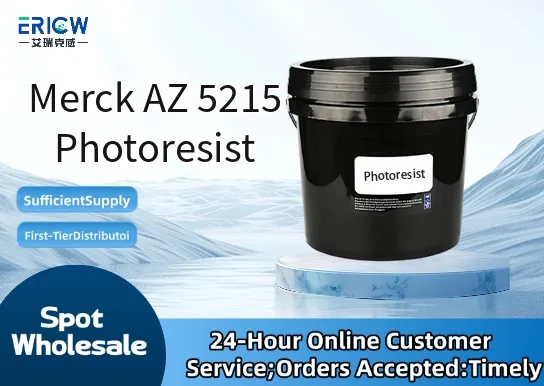
High-resolution positive-tone photoresist optimized for broadband (g/h/i-line) lithography.
Excellent adhesion to silicon, silicon dioxide, and metal substrates without additional primers.
Good thermal stability up to 120 °C post-soft bake and pre-etch conditions.
Controlled dissolution rate in standard aqueous alkaline developers (e.g., 0.26 N TMAH).
Consistent film-forming properties with low defect density and high uniformity across wafers.
Microelectromechanical systems (MEMS) fabrication requiring moderate resolution and robust etch resistance.
Power semiconductor device patterning, including IGBTs and power MOSFETs.
Display driver IC manufacturing using mask aligner-based processes.
Research and development of microfluidic devices on glass or silicon substrates.
Low-cost sensor fabrication where sub-micron resolution is not required.
| Chemical Type | Novolac resin–based positive photoresist with diazonaphthoquinone (DNQ) photoactive compound |
| Product Form | Liquid solution in propylene glycol monomethyl ether acetate (PGMEA) |
| Appearance | Clear, pale yellow liquid, free of visible particles or gels |
| Viscosity (23 °C) | ~2.8–3.2 cP (as supplied, undiluted) |
| Primary Applications | Broadband (g/h/i-line) photolithography for features ≥2 µm |
| Key Features | High sensitivity (~40–80 mJ/cm² at i-line), low standing wave effect, minimal swelling during development |
| Benefits | Process robustness, compatibility with conventional spin-coating and mask aligner tools, wide process latitude |
| Regulatory Compliance | REACH compliant; RoHS 2011/65/EU applicable; no SVHCs above threshold per current SDS |
| Common Compatible Systems | Suitability |
| Mask Aligners (e.g., Karl Suss MA6, EVG 620) | Highly Recommended – Optimized for contact/proximity printing with g/h/i-line sources |
| Spin Coaters (e.g., Laurell WS-650, Headway EC301) | Highly Recommended – Delivers uniform films from 0.8 to 3.0 µm thickness depending on spin speed and dilution |
| Aqueous Alkaline Developers (e.g., 0.26 N TMAH) | Highly Recommended – Standard developer with predictable dissolution kinetics and clean removal |
| Hardbake Hotplates (e.g., Suss SB6, Tokyo Electron CleanTrack) | Recommended – Stable performance with controlled ramp rates and uniform temperature distribution |
Q1: What is the CAS Number for Merck AZ 5215 Photoresist?
A: AZ 5215 is a proprietary formulated product; it does not have a single CAS number. Individual components are listed in the Safety Data Sheet (SDS), with PGMEA assigned CAS 108-65-6 and common novolac resins covered under CAS 9003-35-4.
Q2: What is the typical recommended coating thickness and spin speed range?
A: For 1.5–2.0 µm dry film thickness, spin at 3000–4000 rpm for 30 seconds using undiluted resist; dilution with PGMEA (up to 20% v/v) enables adjustment to 0.8–3.0 µm with corresponding spin speed tuning.
Q3: How does AZ 5215 compare to AZ 5214E in terms of resolution and process window?
A: AZ 5215 offers broader process latitude and higher etch resistance but lower resolution (≥2 µm) than AZ 5214E (sub-micron capable); AZ 5214E provides higher contrast and better thin-film performance, while AZ 5215 excels in step coverage and MEMS-compatible profiles.
Q4: Is AZ 5215 suitable for applications requiring low metal ion contamination?
A: Yes — AZ 5215 is manufactured under strict semiconductor-grade controls and certified for ≤1 ppb Na, K, Fe, Cu, and Ni per batch; full traceability and certificate of analysis (CoA) are available upon request.
Q5: Are there data on extractables or leachables for AZ 5215 in contact with biological media?
A: AZ 5215 is not intended for direct, prolonged contact with biological systems or implantable devices. Extractables testing (per USP <87>/<88>) is not routinely performed; for biomedical microdevice use, qualification under ISO 10993 requires customer-specific validation.
Contact With Us:
E-mail: wangxingqiang@ericwchem.com
Have a Questions? Call Us:
Add:
Building A1, Jiete Industrial Park, Huangpu District, Guangzhou City, Guangdong Province, China