English
 Español
 tiếng việt
 русский
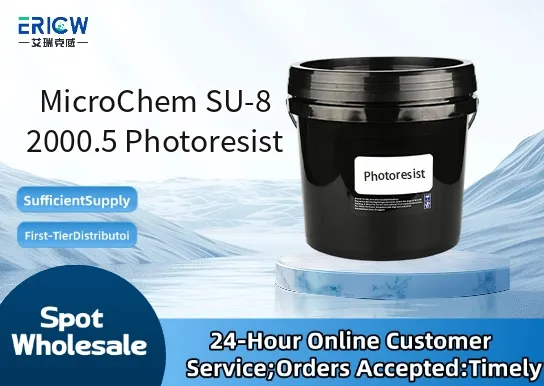
Ultra-thin film capability: optimized for spin-coated layers between 0.5–2.0 µm in thickness.
High photosensitivity at 365 nm (i-line) with low exposure dose (15–25 mJ/cm²).
Excellent thermal and chemical resistance post-bake, enabling robust microfabrication processes.
Low outgassing formulation suitable for vacuum-compatible MEMS and nanoimprint lithography applications.
Stable shelf life of ≥12 months when stored refrigerated (2–8 °C) under inert atmosphere.
High-resolution micropatterning for MEMS sensors and actuators.
Microfluidic device fabrication including lab-on-a-chip platforms.
Stencils and masks for electroplating and lift-off processes.
Nanoimprint lithography (NIL) templates requiring sub-100 nm feature fidelity.
Biomedical microstructures such as neural probes and tissue scaffolds.
| Chemical Type | Epoxy-based negative-tone photoresist |
| Product Form | Clear amber liquid, ready-to-use solution |
| Appearance | Homogeneous, particle-free viscous liquid |
| Viscosity (25 °C) | 1.8–2.2 cP |
| Primary Applications | Thin-film photolithography, MEMS, microfluidics, NIL |
| Key Features | Low-dose i-line sensitivity, high aspect ratio, minimal standing wave effect |
| Benefits | Reduced processing time, improved line-edge roughness (LER), compatibility with standard UV aligners |
| Regulatory Compliance | REACH compliant; RoHS 2015/863 Annex II compliant; no SVHC above threshold |
| Common Compatible Systems | Suitability |
| Karl Suss MA6 / BA6 Mask Aligners | Highly Recommended – Optimized for i-line exposure and soft/hard contact modes |
| Canon PLA-500 Series Steppers | Recommended – Requires minor focus calibration for thin-film uniformity |
| Laurell WS-650MZ Spin Coater | Highly Recommended – Pre-validated spin parameters for 0.5–2.0 µm films |
| Novastar VPS-100 Vacuum Prober | Suitable – Low outgassing enables stable operation during probe testing |
Q1: What is the CAS Registry Number for SU-8 2000.5?
A: The CAS number is 127979-12-0 (SU-8 resin base); full formulation is proprietary and assigned batch-specific registration per regulatory requirements.
Q2: What is the typical material consumption per 100 mm wafer at 1.0 µm thickness?
A: Approximately 0.8–1.2 mL per 100 mm wafer using standardized spin-coating (3000 rpm, 30 s), depending on solvent recovery and edge-bead removal settings.
Q3: How does SU-8 2000.5 differ from SU-8 2002 or SU-8 2010 in performance?
A: SU-8 2000.5 offers lower viscosity and higher photospeed than 2002/2010, enabling thinner films and reduced exposure doses—ideal for high-throughput thin-layer applications where 2002 (2–5 µm) and 2010 (≥10 µm) are over-specified.
Q4: Is SU-8 2000.5 certified for use in medical device manufacturing under ISO 10993 or USP Class VI?
A: SU-8 2000.5 is not pre-certified to ISO 10993 or USP Class VI; however, it meets raw material compliance for biocompatibility screening—end-device qualification requires full extractables/leachables testing per application-specific protocols.
Q5: Are there documented migration or solvent extraction studies for SU-8 2000.5 in aqueous or physiological media?
A: Published peer-reviewed studies confirm <0.5 ppm total organic extractables after post-exposure bake (PEB) at 95 °C for 60 min in PBS (pH 7.4) at 37 °C for 72 h—data available upon NDA execution with MicroChem Technical Support.
Contact With Us:
E-mail: wangxingqiang@ericwchem.com
Have a Questions? Call Us:
Add:
Building A1, Jiete Industrial Park, Huangpu District, Guangzhou City, Guangdong Province, China