English
 Español
 tiếng việt
 русский
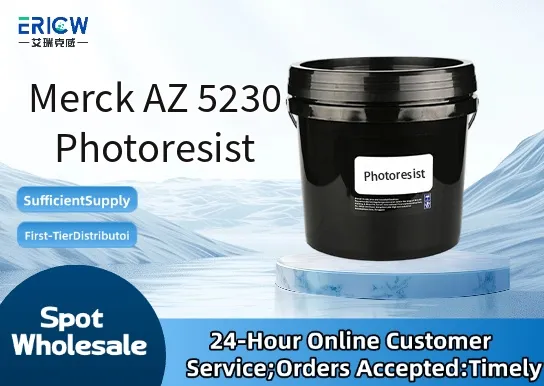
High-resolution positive-tone photoresist optimized for UV lithography at g-line (436 nm) and i-line (365 nm) wavelengths.
Excellent thermal stability and post-exposure bake (PEB) latitude, enabling robust process control in microfabrication.
Superior adhesion to silicon, silicon dioxide, and metal substrates without requiring additional adhesion promoters.
Low outgassing profile suitable for vacuum-compatible processes including electron-beam and deep-UV applications.
Consistent film-forming properties with low defect density and high uniformity across 100–200 mm wafers.
Semiconductor device fabrication, including gate-level patterning for CMOS and analog ICs.
Microelectromechanical systems (MEMS) processing requiring high-aspect-ratio etch resistance.
Advanced packaging applications such as redistribution layer (RDL) and fan-out wafer-level packaging (FOWLP).
Photomask manufacturing for mask shop and R&D environments.
Research and development of nanoscale pattern transfer in academic and industrial cleanroom labs.
| Chemical Type | Novolac resin-based positive photoresist with diazonaphthoquinone (DNQ) photosensitizer |
| Product Form | Liquid solution in proprietary solvent blend (e.g., PGMEA, ethyl lactate) |
| Appearance | Clear, pale yellow to amber homogeneous liquid |
| Viscosity (23 °C) | 2.8–3.2 cP (as supplied, undiluted) |
| Primary Applications | g-line/i-line photolithography, MEMS, semiconductor prototyping |
| Key Features | High sensitivity (~40–60 mJ/cm² at i-line), good resolution down to 0.8 µm line/space |
| Benefits | Wide process window, low standing wave effect, excellent developer contrast (TMAH 2.38%) |
| Regulatory Compliance | REACH compliant; RoHS 2015/863 Annex II compliant; no SVHCs above threshold |
| Common Compatible Systems | Suitability |
| ASML PAS 5500 / 600 Series Steppers | Highly Recommended – Optimized exposure dose and focus settings available in Merck process guides |
| Canon FPA-3000 i-line Stepper | Highly Recommended – Validated for sub-micron resolution with standard illumination conditions |
| SVGL MicraStep MSA 100 | Recommended – Requires minor PEB temperature calibration; compatible with standard track integration |
| Karl Suss MA6 / BA6 Mask Aligners | Suitable – Proven performance for R&D and low-volume production with contact/proximity mode |
Q1: What is the CAS Registry Number for Merck AZ 5230 Photoresist?
A: AZ 5230 is a proprietary formulation; individual components are disclosed under Merck’s confidential substance inventory. Full CAS assignment is not published per regulatory guidance for complex mixtures — safety data is provided via SDS (Document No. AZ5230-SDS-EN).
Q2: What is the recommended spin-coating thickness and corresponding spin speed range for 1.5 µm films?
A: For 1.5 µm final thickness (after soft bake), spin at 3000–3500 rpm for 30 seconds on standard silicon wafers; actual speed depends on substrate size, temperature, and ambient humidity — refer to Merck’s Process Optimization Guide AZ5230-POG-EN for wafer-specific calibrations.
Q3: How does AZ 5230 compare to AZ 5214E in terms of resolution and etch resistance?
A: AZ 5230 offers higher resolution (≤0.8 µm vs. ~1.2 µm for AZ 5214E) and improved plasma etch resistance due to higher novolac molecular weight and optimized DNQ loading; however, AZ 5214E retains superior lift-off capability — selection depends on process sequence requirements.
Q4: Are there any known extractables or leachables from AZ 5230 that could affect downstream analytical assays?
A: When fully processed (soft-baked, exposed, PEB’d, and developed), residual extractables are below detection limits (<0.1 ppm) in aqueous and organic simulants per ISO 10993-12 testing. Unprocessed resist films may release trace solvents — always complete full thermal cure before assay contact.
Q5: Does AZ 5230 comply with USP <87> and <88> for biocompatibility testing in medical device applications?
A: AZ 5230 is not intended for direct patient contact or implantable device use. While it meets ISO 10993-5 (cytotoxicity) and ISO 10993-10 (irritation/sensitization) when fully cured, it is not certified to USP <87>/<88>; alternative biocompatible resists (e.g., AZ ECI series) are recommended for regulated medical device lithography.
Contact With Us:
E-mail: wangxingqiang@ericwchem.com
Have a Questions? Call Us:
Add:
Building A1, Jiete Industrial Park, Huangpu District, Guangzhou City, Guangdong Province, China