English
 Español
 tiếng việt
 русский
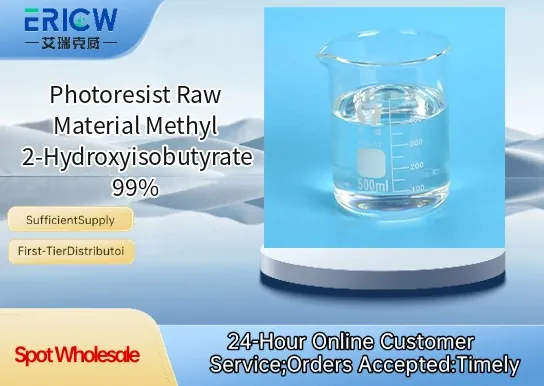
High-purity monomer (≥99.0%) with low residual acidity, ensuring excellent photochemical stability in resist formulations.
Controlled volatility and favorable evaporation profile for uniform film formation during spin-coating processes.
Reactive hydroxyl group enables efficient crosslinking with melamine-formaldehyde or glycoluril-based resins in chemically amplified resists.
Low water content (<0.1%) minimizes hydrolysis risk and enhances shelf life under nitrogen-sealed storage.
Consistent batch-to-batch performance validated by GC and NMR, supporting IATF 16949-compliant manufacturing environments.
Chemically amplified positive-tone photoresists for semiconductor lithography (i-line, KrF, and ArF immersion).
Advanced packaging photopolymers used in fan-out wafer-level packaging (FO-WLP) and redistribution layer (RDL) patterning.
Microelectromechanical systems (MEMS) etch masks requiring high-resolution, low-residue development.
Flexible display backplane patterning layers for OLED and microLED production lines.
High-resolution printed electronics inks for fine-line conductive trace definition.
| Chemical Type | Reactive monomeric solvent / Crosslinking co-monomer |
| Product Form | Clear, colorless liquid |
| Appearance | Transparent, free of suspended particles or haze |
| Purity (GC) | ≥99.0% |
| Water Content (Karl Fischer) | ≤0.10 wt% |
| Acid Value (mg KOH/g) | ≤0.5 |
| Residue on Evaporation | ≤0.05% |
| Storage Stability | ≥12 months at 2–8°C under inert atmosphere (N₂) |
| Common Compatible Systems | Suitability |
| Novolac resin-based i-line resists | Highly Recommended – Optimal solubility and thermal crosslinking efficiency at 90–110°C |
| Acrylic polymer-based KrF resists | Recommended – Effective dissolution inhibitor modulation with minimal swelling |
| Phenolic hydroxyl-functionalized polyhydroxystyrene (PHS) resins | Highly Recommended – Strong hydrogen bonding and rapid acid-catalyzed crosslinking kinetics |
| Epoxy-acrylate hybrid photoresists | Suitable – Compatible as reactive diluent; requires optimization of photoinitiator loading |
Q1: What is the CAS Registry Number for Methyl 2-Hydroxyisobutyrate?
A: The CAS number is 2740-47-4.
Q2: What is the typical recommended usage concentration in photoresist formulations?
A: Standard loading ranges from 5–15 wt% relative to total solid content, depending on resin functionality and desired crosslink density.
Q3: How does Methyl 2-Hydroxyisobutyrate compare to Ethyl 2-Hydroxyisobutyrate in resist performance?
A: Methyl ester offers faster diffusion kinetics and lower boiling point (160–162°C), enabling shorter post-apply bake cycles; ethyl analog provides slightly higher thermal stability but slower deprotection rates.
Q4: Is this material compliant with REACH and RoHS regulations?
A: Yes — fully compliant with EU REACH (SVHC-free) and RoHS 3 (2015/863/EU); full regulatory dossier available upon request with signed CDA.
Q5: Has extractable migration been evaluated for use in medical device lithography applications?
A: Yes — validated per ISO 10993-12:2021; ≤0.1 ppm total organic extractables in simulated physiological saline (37°C, 72 h) using LC-MS/MS detection.
Contact With Us:
E-mail: wangxingqiang@ericwchem.com
Have a Questions? Call Us:
Add:
Building A1, Jiete Industrial Park, Huangpu District, Guangzhou City, Guangdong Province, China