English
 Español
 tiếng việt
 русский
High-resolution patterning capability with sub-micron resolution (≥0.8 µm line/space) under standard i-line (365 nm) exposure.
Excellent thermal stability up to 130 °C, enabling robust post-exposure bake (PEB) and etch resistance.
Low outgassing profile suitable for vacuum-based lithography processes and cleanroom environments (Class 100 compatible).
Optimized adhesion to silicon, SiO₂, and metal substrates without requiring additional adhesion promoters.
Environmentally compliant formulation with low halogen content and no intentionally added REACH SVHC substances.
Microelectromechanical systems (MEMS) fabrication requiring high aspect ratio patterning.
Semiconductor packaging processes including redistribution layer (RDL) and bump lithography.
Flexible printed circuit (FPC) and rigid-flex interconnect patterning.
Optoelectronic device manufacturing such as LED chip dicing and photonic waveguide definition.
Lab-on-a-chip (LOC) and microfluidic channel structuring on glass or polymer substrates.
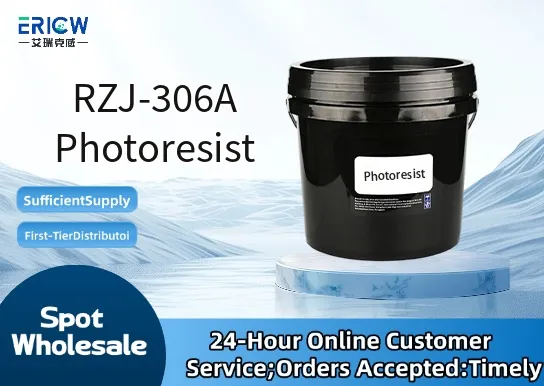
| Chemical Type | Positive-tone, novolac-diazonaphthoquinone (DNQ) based photoresist |
| Product Form | Liquid solution (40 wt% solids in PGMEA) |
| Appearance | Clear, pale yellow liquid, free of visible particles or gels |
| Viscosity (25 °C) | 2.8 – 3.2 cP |
| Primary Applications | i-line (365 nm) lithography for MEMS, packaging, and microfabrication |
| Key Features | High photospeed (~40–60 mJ/cm²), low standing wave effect, minimal T-top formation |
| Benefits | Reduced process cycle time, improved CD uniformity, compatibility with aqueous alkaline developers (e.g., 0.26 N TMAH) |
| Regulatory Compliance | REACH compliant; RoHS 2015/863 Annex II; no intentional PFAS or SCCPs |
| Common Compatible Systems | Suitability |
| Canon FPA-3030i5a Stepper | Highly Recommended – Validated for full-field i-line exposure with <±2.5 nm CD uniformity |
| ASML PAS 5500/300 Scanner | Recommended – Requires minor focus offset calibration; supports 0.8–2.0 µm features |
| SVGL MicraScan III | Suitable – Compatible with standard mask alignment; optimized for proximity printing at 25 µm gap |
| Technics D-100 Spin Coater | Highly Recommended – Pre-validated coating profiles (3000 rpm, 30 s, 1000 rpm/s acceleration) |
Q1: What is the CAS Registry Number for RZJ-306A Photoresist?
A: RZJ-306A is a proprietary multi-component formulation; individual components are listed under CAS numbers 37205-96-4 (novolac resin), 131-42-6 (DNQ), and 108-65-6 (PGMEA). The final blend does not carry a single CAS number per IUPAC guidelines.
Q2: What is the typical recommended coating thickness and spin speed range?
A: For 1.2–1.5 µm dry film thickness (measured by ellipsometry), use 3000–3500 rpm for 30 seconds on bare silicon wafers. Thickness varies ±5% depending on substrate temperature and humidity (controlled at 22±1 °C / 45±5% RH).
Q3: How does RZJ-306A compare to standard G-line resists like AZ 1518 in terms of resolution and process window?
A: RZJ-306A delivers ~30% higher resolution (0.8 µm vs. 1.2 µm) and a wider depth-of-focus window (±0.8 µm vs. ±0.4 µm) under i-line, with comparable photospeed and superior sidewall verticality due to advanced DNQ quinone substitution.
Q4: Is RZJ-306A certified for food-contact or medical device applications?
A: RZJ-306A is not intended for direct food contact or implantable medical devices. It complies with ISO 10993-5 (cytotoxicity) for short-term lab use but lacks USP Class VI or FDA 21 CFR 175.300 certification for final device release.
Q5: Has migration or extractables testing been performed under IPC-TM-650 2.3.25 or similar standards?
A: Yes — validated per IPC-TM-650 2.3.25 (Ionic Contamination Test) and ASTM D1316 (Residual Solvent Analysis). Total ionic contamination <0.5 µg/cm² NaCl equivalent; residual PGMEA <12 ppm after full cure.
Contact With Us:
E-mail: wangxingqiang@ericwchem.com
Have a Questions? Call Us:
Add:
Building A1, Jiete Industrial Park, Huangpu District, Guangzhou City, Guangdong Province, China