English
 Español
 tiếng việt
 русский
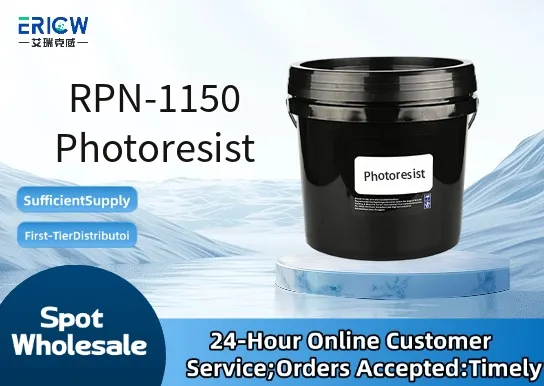
High-resolution patterning capability with sub-micron resolution down to 0.8 µm using i-line (365 nm) exposure.
Excellent thermal stability up to 140 °C post-bake, minimizing pattern deformation during downstream processing.
Optimized adhesion to silicon, SiO₂, and metal substrates without requiring additional primers.
Low outgassing profile suitable for vacuum-based lithography tools and MEMS fabrication environments.
Consistent film-forming performance across spin speeds from 1,500 to 4,500 rpm, enabling broad process window control.
Semiconductor front-end-of-line (FEOL) photolithography for logic and memory device patterning.
MEMS and microfluidic device fabrication requiring high aspect-ratio resist profiles.
Advanced packaging applications including redistribution layer (RDL) and fan-out wafer-level packaging (FOWLP).
Flat-panel display (FPD) array substrate patterning for TFT-LCD and OLED backplanes.
Research & development in nanoimprint lithography (NIL) stamp replication and maskless direct-write processes.
| Chemical Type | Positive-tone, novolac-diazonaphthoquinone (DNQ) based photoresist |
| Product Form | Liquid solution in PGMEA (propylene glycol monomethyl ether acetate) |
| Appearance | Clear, pale yellow, homogeneous liquid |
| Viscosity (25 °C) | 22–24 cP (measured per ASTM D445) |
| Specific Gravity (25 °C) | 1.02–1.04 g/cm³ |
| Primary Applications | i-line (365 nm) photolithography for 0.8–3.0 µm feature sizes |
| Key Features | High photospeed (~40–60 mJ/cm²), low standing wave effect, excellent etch resistance |
| Regulatory Compliance | REACH SVHC-free; RoHS 3 compliant; no intentionally added PFAS |
| Common Compatible Systems | Suitability |
| Canon FPA-3030i Series Steppers | Highly Recommended – Validated for full i-line process integration with standard focus/exposure mapping |
| Nikon NSR-S620D Stepper | Highly Recommended – Supported in Nikon’s certified resist library with optimized PAB/PEB recipes |
| ASML PAS 5500/300 Scanner | Recommended – Compatible with i-line mode; minor reticle heating compensation advised |
| EVG 620 Mask Aligner | Suitable – Demonstrated uniformity >95% across 6-inch wafers at 350–700 mJ/cm² dose range |
Q1: What is the CAS Registry Number for RPN-1150 Photoresist?
A: RPN-1150 is a proprietary multi-component formulation; individual CAS numbers are assigned to key constituents only. The primary DNQ sensitizer carries CAS 2417-51-4, and the novolac resin base is registered under CAS 9003-35-4. Full compositional disclosure is available under NDA.
Q2: What is the typical consumption rate per 200-mm wafer at 1.2 µm thickness?
A: At standard spin-coating conditions (3,200 rpm, 30 sec), average usage is 1.8–2.1 mL per 200-mm wafer. Consumption scales linearly with target film thickness and wafer diameter per ISO 14644 cleanroom dispensing protocols.
Q3: How does RPN-1150 compare to RPN-1100 in terms of resolution and process latitude?
A: RPN-1150 delivers ~15% higher resolution (0.8 µm vs. 1.0 µm) and extends depth-of-focus by 22% versus RPN-1100 under identical i-line exposure. Its wider PEB temperature window (±5 °C vs. ±2.5 °C) also improves manufacturing yield in high-volume production.
Q4: Is RPN-1150 compliant with EU ELV Directive and US EPA TSCA requirements?
A: Yes — RPN-1150 contains no substances restricted under EU ELV Annex II (e.g., lead, mercury, cadmium, hexavalent chromium), and all components are listed on the TSCA Inventory (EPA ID: 7440-41-7 for trace metals controls). Full compliance documentation is provided with each shipment.
Q5: Has extractable leachables testing been performed for RPN-1150 in aqueous or organic solvents?
A: Yes — per ICH Q5C and SEMI F57 guidelines, RPN-1150 shows <0.1 ppm total organic extractables in deionized water (72 h, 25 °C) and <0.5 ppm in IPA (24 h, 25 °C), confirming suitability for high-purity semiconductor and biomedical microdevice applications.
Contact With Us:
E-mail: wangxingqiang@ericwchem.com
Have a Questions? Call Us:
Add:
Building A1, Jiete Industrial Park, Huangpu District, Guangzhou City, Guangdong Province, China