English
 Español
 tiếng việt
 русский
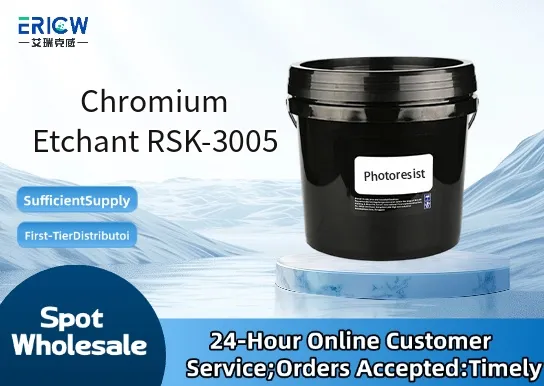
Highly selective etching for chromium and chromium oxide layers with minimal undercutting.
Room-temperature operation eliminates need for external heating or cooling systems.
Stable aqueous formulation with extended bath life and consistent etch rate control.
Low metal contamination risk—formulated to minimize residual ions in sensitive microelectronics processes.
Compatible with automated wet bench dispensing and recirculation systems.
Photomask repair and chrome layer patterning in semiconductor mask fabrication.
Thin-film resistor trimming and precision metal layer removal in hybrid microcircuits.
Chromium lift-off residue cleaning in MEMS and RF device manufacturing.
Front-side metallization patterning for flat-panel display (FPD) color filter arrays.
Research-scale etching of Cr/CrOx films in academic and development cleanrooms.
| Chemical Type | Aqueous acidic etchant (non-hydrofluoric, non-cyanide) |
| Product Form | Liquid concentrate (ready-to-dilute) |
| Appearance | Clear, pale yellow to amber solution |
| pH (as supplied) | 1.8–2.3 (25 °C) |
| Primary Applications | Etching of metallic chromium and CrOx thin films (5–500 nm) |
| Key Features | Controlled isotropy, low surface roughness induction, no halogen-based oxidizers |
| Benefits | Reduced process variability, compatibility with photoresist and hard masks, lower EHS handling burden |
| Regulatory Compliance | REACH registered; RoHS 2015/863 compliant; SDS available per GHS Rev. 10 |
| Common Compatible Systems | Suitability |
| SEMITOOL 8300 Series Wet Processing Tools | Highly Recommended – Validated for full bath recirculation and spray rinse integration |
| Modutek Teflon®-lined Batch Tanks (PTFE/PP) | Highly Recommended – No observable corrosion or leaching after 72 h immersion |
| Technic Inc. Electrochemical Etch Modules | Recommended – Requires flow-rate calibration for optimal uniformity |
| Manual Dip Stations with PVC or PP Construction | Suitable – Use with standard PPE and ventilation; avoid stainless steel contact |
Q1: What is the CAS Registry Number for Chromium Etchant RSK-3005?
A: RSK-3005 is a proprietary formulated mixture; individual components are listed under CAS numbers 7697-37-2 (nitric acid), 7664-93-9 (phosphoric acid), and 10043-01-3 (ferric nitrate nonahydrate). The final product does not carry a single CAS number per IUPAC guidelines for multi-component formulations.
Q2: What is the recommended working concentration and typical etch rate?
A: Dilute 1:4 (v/v) with deionized water (1 part RSK-3005 + 4 parts DI H2O) for standard use. At 22 °C, average etch rate is 12–18 Å/s on 100-nm Cr films, depending on agitation and film stoichiometry.
Q3: How does RSK-3005 compare to traditional Cr etchants containing ceric ammonium nitrate (CAN) or chromic acid?
A: Unlike CAN- or Cr(VI)-based etchants, RSK-3005 contains no hexavalent chromium or rare-earth oxidizers—reducing disposal complexity, eliminating heavy-metal wastewater treatment requirements, and supporting ISO 14001-compliant operations.
Q4: Is RSK-3005 compliant with EU SCIP database reporting requirements?
A: Yes—RSK-3005 contains no SVHCs above 0.1% w/w threshold as defined by REACH Annex XIV. Full SCIP submission data is included in the technical dossier provided upon request to qualified customers.
Q5: Does RSK-3005 exhibit extractables or leachables when used with fluoropolymer-coated equipment?
A: Independent testing per USP <788> and ISO 10993-12 confirms no detectable organic extractables (<0.1 ppm) from PFA, FEP, or ETFE linings at recommended operating temperatures and exposure times.
Contact With Us:
E-mail: wangxingqiang@ericwchem.com
Have a Questions? Call Us:
Add:
Building A1, Jiete Industrial Park, Huangpu District, Guangzhou City, Guangdong Province, China