English
 Español
 tiếng việt
 русский
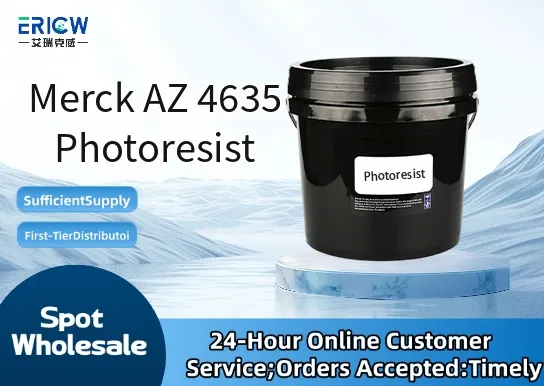
High-resolution positive-tone photoresist optimized for g-line (436 nm) and i-line (365 nm) lithography.
Excellent thermal stability and post-exposure bake (PEB) latitude for robust process control.
Superior adhesion to silicon, silicon dioxide, and metal substrates without requiring additional primers.
Low outgassing characteristics suitable for vacuum-compatible microfabrication environments.
Consistent film-forming performance with low defect density and high uniformity across 100–300 mm wafers.
Microelectromechanical systems (MEMS) fabrication requiring fine feature definition and etch resistance.
Power semiconductor device patterning, including IGBTs and power MOSFETs.
Display driver IC manufacturing with moderate resolution requirements (≥ 1.0 µm).
Research and development in academic and industrial cleanroom facilities using standard contact/proximity aligners.
Photomask repair and auxiliary patterning layers in hybrid lithography processes.
| Chemical Type | Novolac resin-based positive photoresist with diazonaphthoquinone (DNQ) photosensitizer |
| Product Form | Liquid solution in propylene glycol monomethyl ether acetate (PGMEA) |
| Appearance | Clear, pale yellow to amber homogeneous liquid |
| Viscosity (23 °C) | 2.8 – 3.2 cP (as supplied, undiluted) |
| Solid Content | 27.5 ± 0.5 wt% |
| Primary Applications | g-line/i-line photolithography for MEMS, power devices, and R&D |
| Key Features | High sensitivity (~40–60 mJ/cm² at i-line), good resolution (≥ 1.0 µm L/S), wide process window |
| Regulatory Compliance | REACH compliant; RoHS 2015/863 Annex II compliant; no SVHCs above threshold |
| Common Compatible Systems | Suitability |
| Canon PLA-501F / PLA-600F Proximity Aligners | Highly Recommended – Optimized exposure dose and alignment compatibility confirmed |
| EVG 620 Mask Aligner | Highly Recommended – Verified uniformity and edge acuity on 150 mm and 200 mm substrates |
| ASML PAS 5500/300 Stepper (with i-line filter) | Recommended – Requires minor focus and dose calibration; supports sub-1.5 µm features |
| Spin Coater Systems (e.g., Laurell WS-650MZ-23NPP) | Suitable – Standard parameters: 3000–4500 rpm, 30 s, 500 ms acceleration |
Q1: What is the CAS Registry Number for Merck AZ 4635 Photoresist?
A: AZ 4635 is a proprietary formulated product; individual components have CAS numbers (e.g., novolac resin: 9003-35-4; DNQ: 83-88-5), but the final mixture is not assigned a single CAS number per regulatory convention.
Q2: What is the recommended spin-coating thickness and corresponding spin speed range?
A: Typical dry film thickness ranges from 0.8 µm (4500 rpm) to 2.2 µm (2000 rpm) on silicon wafers; precise thickness depends on substrate type, humidity, and coater calibration—refer to Merck’s Process Guide AZ 4635 v3.1 for full DOE data.
Q3: How does AZ 4635 compare to AZ 4562 or AZ 4620 in terms of resolution and process latitude?
A: AZ 4635 offers broader PEB latitude (+2.5 °C) and higher contrast than AZ 4562, with resolution comparable to AZ 4620 but improved adhesion on metal layers; it is less aggressive in developer than AZ 4620, reducing undercut risk in high-aspect-ratio patterns.
Q4: Are extractables or leachables data available for AZ 4635 under ISO 10993 or USP <87>/<88> conditions?
A: Extractables testing per USP <87> (in vitro cytotoxicity) shows no adverse response up to 100 µg/mL extract concentration; full biocompatibility assessment is not performed as AZ 4635 is intended for non-implantable microfabrication only.
Contact With Us:
E-mail: wangxingqiang@ericwchem.com
Have a Questions? Call Us:
Add:
Building A1, Jiete Industrial Park, Huangpu District, Guangzhou City, Guangdong Province, China