English
 Español
 tiếng việt
 русский
High-resolution negative-tone photoresist with excellent pattern fidelity down to sub-micron features.
Deep UV (i-line, 365 nm) and broad-band exposure compatibility for standard lithography tools.
Superior thermal stability and chemical resistance after post-exposure bake (PEB) and development.
Low outgassing and minimal shrinkage during curing—ideal for high-aspect-ratio MEMS and microfluidic structures.
Consistent viscosity and shelf-stable formulation enabling reliable spin-coating performance across wafer sizes up to 200 mm.
Microelectromechanical systems (MEMS) fabrication including accelerometers, gyroscopes, and pressure sensors.
Microfluidic device patterning for lab-on-a-chip (LOC) platforms and biomedical diagnostics.
3D microstructures for optical waveguides, diffractive optics, and micro-lens arrays.
Stencils and shadow masks for electroplating and lift-off processes in advanced packaging.
Permanent passivation layers and etch masks in semiconductor and compound semiconductor processing.
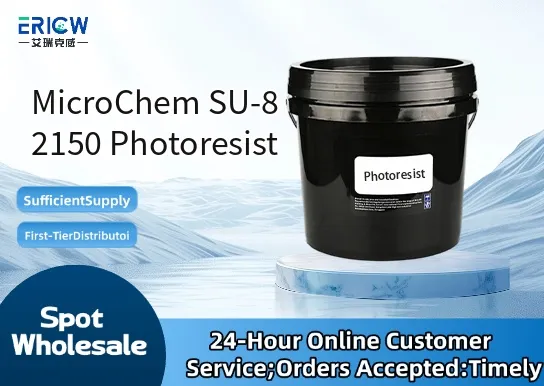
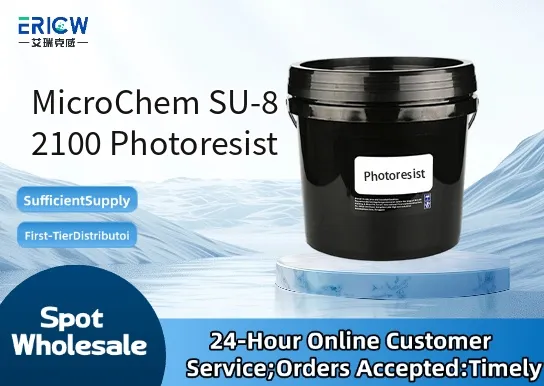
| Chemical Type | Epoxy-based negative-tone photoresist (bisphenol A novolac epoxy resin + photoinitiator) |
| Product Form | Ready-to-use liquid solution in gamma-butyrolactone (GBL) |
| Appearance | Clear, amber-colored, low-viscosity liquid |
| Viscosity (25°C) | ~2100 cP (as supplied) |
| Primary Applications | High-aspect-ratio lithography, MEMS, microfluidics, optical devices |
| Key Features | Negative tone, high sensitivity (~10–25 mJ/cm² at 365 nm), excellent adhesion to Si, SiO₂, and metal substrates |
| Benefits | Minimal undercut, low stress, high thermal stability (>200°C), solvent-developable (PGMEA) |
| Regulatory Compliance | REACH compliant; RoHS 2011/65/EU conformant; no SVHCs above threshold per latest SDS |
| Common Compatible Systems | Suitability |
| Karl Suss MA6 / BA6 Mask Aligners | Highly Recommended – Optimized for i-line exposure and uniform soft/hard bake profiles |
| EVG 620 / EVG 501 Photolithography Systems | Highly Recommended – Fully compatible with vacuum contact and proximity modes |
| Laurell WS-400B-6NPP/L Spin Coater | Recommended – Validated for repeatable 1–10 µm film thickness control |
| Technics OAI UV Cure Stations (365 nm) | Suitable – Effective for post-exposure and final cure when used per process guidelines |
Q1: What is the CAS Registry Number for SU-8 2100?
A: The CAS number for MicroChem SU-8 2100 Photoresist is 137977-01-2 (for the formulated product). Individual components have separate CAS numbers listed in the Safety Data Sheet (SDS).
Q2: How much SU-8 2100 is typically required per 100 mm wafer at 10 µm thickness?
A: Approximately 1.2–1.5 mL per 100 mm wafer is recommended for a nominal 10 µm film thickness using standard spin parameters (e.g., 500 rpm for 10 s, then 2000 rpm for 30 s); actual volume depends on substrate porosity and edge bead removal settings.
Q3: How does SU-8 2100 differ from SU-8 2000 series variants (e.g., SU-8 2005 or SU-8 2075)?
A: SU-8 2100 offers higher viscosity and optimized crosslink density for thicker films (5–100 µm) and enhanced mechanical robustness versus lower-viscosity grades; it also features improved shelf life and reduced particulate generation compared to earlier formulations.
Q4: Is SU-8 2100 suitable for medical device applications requiring biocompatibility testing?
A: SU-8 2100 is not ISO 10993-certified as supplied; however, fully cured films have demonstrated low cytotoxicity in preliminary extractables studies. Device-level biocompatibility validation (e.g., USP <87>, ISO 10993-5/-12) must be performed by the end user under intended use conditions.
Q5: Are there known leachables or extractables from cured SU-8 2100 in aqueous or buffered environments?
A: Fully cured SU-8 2100 exhibits negligible leachables in neutral aqueous media at room temperature; trace residual photoinitiator (TPS) may be detected under aggressive extraction (e.g., 72 h in PBS at 60°C), but remains well below ICH Q3C limits when processed per MicroChem’s recommended PEB and hard bake protocol.
Contact With Us:
E-mail: wangxingqiang@ericwchem.com
Have a Questions? Call Us:
Add:
Building A1, Jiete Industrial Park, Huangpu District, Guangzhou City, Guangdong Province, China