English
 Español
 tiếng việt
 русский
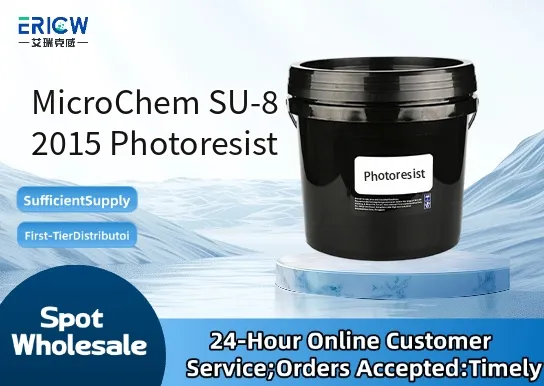
High-resolution negative-tone photoresist with sub-micron patterning capability (down to 0.5 µm line/space).
Excellent thermal stability and chemical resistance post-bake, enabling robust microfabrication processes.
Low outgassing formulation suitable for vacuum-compatible MEMS and micro-optics applications.
Optimized viscosity (~15 cP at 25 °C) for uniform spin-coating on silicon, glass, and metal substrates.
UV-sensitive epoxy-based chemistry with high photosensitivity at 365 nm (i-line) exposure.
MEMS device fabrication including accelerometers, pressure sensors, and microfluidic channels.
Micro-optics and photonic integrated circuit (PIC) waveguide patterning.
High-aspect-ratio lithography for LIGA-like structures and micro-molds.
Biomedical microdevices such as lab-on-a-chip platforms and cell-culture scaffolds.
Wafer-level packaging and redistribution layer (RDL) patterning in advanced semiconductor assembly.
| Chemical Type | Epoxy-based negative-tone photoresist |
| Product Form | Liquid, ready-to-use solution |
| Appearance | Clear, pale yellow viscous liquid |
| Viscosity (25 °C) | 14–16 cP |
| Primary Applications | Microlithography for MEMS, microfluidics, photonics, and packaging |
| Key Features | High resolution, low shrinkage, excellent adhesion to Si/SiO₂/Cr/Au |
| Benefits | Reduced process steps, minimal post-exposure bake drift, stable shelf life (≥6 months refrigerated) |
| Regulatory Compliance | REACH compliant; RoHS 2015/863 Annex II: compliant (SVHC-free) |
| Common Compatible Systems | Suitability |
| Mask Aligners (e.g., Karl Suss MA6/BA6, EVG 620) | Highly Recommended – Optimized for i-line (365 nm) exposure with standard quartz masks |
| Spin Coaters (e.g., Laurell WS-400B-6NPP/LAB, Headway EC301) | Highly Recommended – Precise thickness control (1.5–2.0 µm @ 3000 rpm) |
| Hot Plates & Convection Ovens (e.g., Novocontrol BPT-100, Blue M) | Recommended – Uniform soft-bake and post-exposure bake profiles supported |
| Developer Systems (e.g., Tokyo Electron CD-2100, SSEC D-300) | Suitable – Compatible with standard 1:1 PGMEA:IPA developer mixtures |
Q1: What is the CAS Registry Number for SU-8 2015?
A: The CAS number for MicroChem SU-8 2015 Photoresist is 137777-90-7 (as assigned to the proprietary epoxy resin matrix formulation).
Q2: How much SU-8 2015 is typically consumed per 100 mm wafer at 2 µm thickness?
A: Approximately 0.8–1.2 mL per 100 mm wafer (depending on spin speed and edge bead removal protocol); a 100 mL bottle supports ~100–120 wafers under standard conditions.
Q3: How does SU-8 2015 differ from SU-8 2002 or SU-8 2075 in terms of processing?
A: SU-8 2015 offers lower viscosity than SU-8 2075 (enabling thinner films) and higher resolution than SU-8 2002 due to optimized photoacid generator concentration and reduced diffusion during PEB.
Q4: Is SU-8 2015 certified for use in ISO 10993-compliant biomedical devices?
A: SU-8 2015 is not ISO 10993-certified as a finished device material; however, it meets USP Class VI extractables limits when fully crosslinked and post-processed per MicroChem’s recommended hard bake (200 °C, 30 min), supporting biocompatibility screening.
Q5: Are there documented migration or leaching studies for SU-8 2015 in aqueous or saline environments?
A: Peer-reviewed extraction studies (e.g., J. Micromech. Microeng. 2021) report <0.5 ppm total organic extractables after 7-day immersion in PBS (pH 7.4, 37 °C) following full cure, confirming suitability for short-term in vitro bioassays.
Contact With Us:
E-mail: wangxingqiang@ericwchem.com
Have a Questions? Call Us:
Add:
Building A1, Jiete Industrial Park, Huangpu District, Guangzhou City, Guangdong Province, China