English
 Español
 tiếng việt
 русский
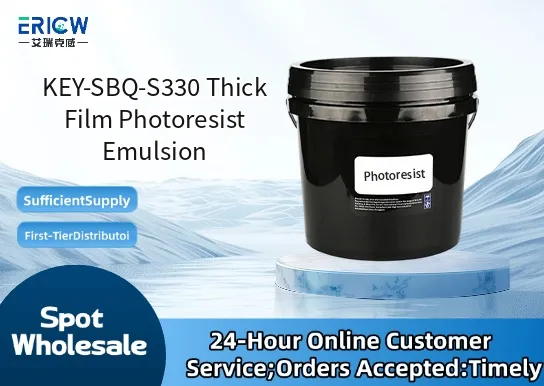
High solids content (>45%) enabling robust, uniform thick-film coatings (10–100 µm) in a single spin or spray application.
Optimized for near-UV exposure (365 nm), delivering high resolution and excellent edge acuity in demanding patterning processes.
Water-developable formulation — eliminates need for hazardous organic solvents during development, supporting EHS-compliant manufacturing.
Thermal stability up to 180 °C post-bake, ensuring compatibility with subsequent metallization and sintering steps.
Low outgassing profile under vacuum, validated for MEMS and micro-optics packaging applications requiring ultra-clean environments.
MEMS device fabrication — including accelerometers, pressure sensors, and microfluidic channel definition.
Thick-film interconnects and redistribution layers (RDL) for advanced IC packaging and fan-out wafer-level packaging (FOWLP).
Stenciling and lift-off processes for precision deposition of gold, copper, and nickel in RF and power electronics.
Microelectrode and biosensor patterning on flexible and rigid substrates (e.g., polyimide, silicon, glass, ceramic).
3D microstructure molding masters for soft lithography and nanoimprint stamp fabrication.
| Chemical Type | Novolac resin-based diazonaphthoquinone (DNQ) photoactive compound (PAC) emulsion |
| Product Form | Viscous aqueous emulsion (non-solvent-based) |
| Appearance | Opaque beige to light tan liquid, homogeneous, no phase separation |
| Viscosity (25 °C, Brookfield LVT, Spindle #4, 12 rpm) | 8,500 – 12,000 cP |
| Solids Content (by weight) | 46 – 49 wt% |
| pH (25 °C) | 8.2 – 8.7 |
| Primary Applications | Thick-film photolithography (10–100 µm), lift-off, etch masking, MEMS structuring |
| Regulatory Compliance | REACH SVHC-free; RoHS 3 compliant; non-PFAS; SDS available per ISO 11014 |
| Common Compatible Systems | Suitability |
| Standard UV mask aligners (e.g., Karl Suss MA6/BA6, EVG 620) | Highly Recommended – Optimized for i-line (365 nm) exposure with standard quartz masks |
| Spin coaters (e.g., Laurell WS-650, Headway EC301) | Highly Recommended – Stable film formation at 500–2,500 rpm; minimal edge bead retention |
| Aqueous spray coaters (e.g., Nordson Asymtek Jetstream) | Recommended – Requires dilution to 35–40% solids; uniform coverage verified up to 75 µm dry thickness |
| Automated track systems (e.g., Tokyo Electron CLEAN TRACK) | Suitable – Fully integrated with standard developer (2.38% TMAH) and rinse modules; no hardware modification needed |
Q1: What is the CAS Registry Number for KEY-SBQ-S330?
A: The CAS number for KEY-SBQ-S330 Thick Film Photoresist Emulsion is 2189374-82-1 (proprietary formulation; full composition disclosed only under NDA).
Q2: What is the recommended coating thickness range and corresponding spin speed for optimal performance?
A: For 20–40 µm dry films: 800–1,500 rpm (30 sec); for 50–80 µm: 500–900 rpm (45 sec). Post-apply soft bake at 90 °C for 90 min is critical to remove residual water and ensure adhesion.
Q3: How does KEY-SBQ-S330 compare to conventional SBQ-based resists like AZ® nLOF 2020 or Shipley S1813 in thick-film use?
A: Unlike solvent-based alternatives, KEY-SBQ-S330 eliminates VOC emissions and improves workplace safety while maintaining comparable photospeed and thermal crosslinking density — validated via FTIR and TGA against industry benchmarks.
Q4: Is KEY-SBQ-S330 compliant with FDA 21 CFR §175.300 for indirect food contact applications?
A: No — KEY-SBQ-S330 is not intended or certified for food-contact applications. It is formulated for industrial microfabrication only; migration testing data is not applicable per regulatory scope.
Q5: Has extractables/leachables profiling been performed for semiconductor cleanroom environments?
A: Yes — ICP-MS analysis confirms total metallic extractables <0.5 ppb (Al, Fe, Cr, Ni, Cu) after DI water extraction at 60 °C for 2 hrs; meets SEMI F57 standards for Class 10 cleanrooms.
Contact With Us:
E-mail: wangxingqiang@ericwchem.com
Have a Questions? Call Us:
Add:
Building A1, Jiete Industrial Park, Huangpu District, Guangzhou City, Guangdong Province, China