English
 Español
 tiếng việt
 русский
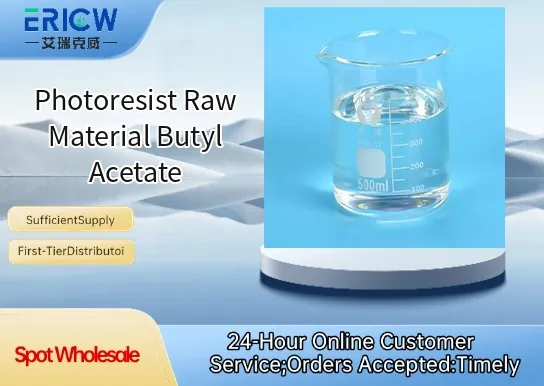
High-purity solvent specifically refined for photoresist formulation to minimize particulate and ionic contamination.
Optimized evaporation rate ensures uniform film formation and controlled coating viscosity in spin-coating processes.
Low water content (<0.05% w/w) prevents hydrolysis of acid-labile photoresist resins during storage and processing.
Consistent batch-to-batch performance validated via GC-FID and trace metal analysis (ICP-MS).
Non-reactive with common novolac, polyhydroxystyrene, and chemically amplified resist polymers.
Primary solvent in g-line and i-line positive photoresists for semiconductor wafer fabrication.
Diluent component in advanced EUV photoresist top-coat and underlayer formulations.
Carrier medium for photoacid generators (PAGs) and dissolution inhibitors in high-resolution resist blends.
Co-solvent in multilayer resist systems requiring balanced solubility parameters (HSP δt ≈ 17.3 MPa1/2).
Processing aid in photomask manufacturing for chrome-on-glass and quartz substrate patterning.
| Chemical Type | Organic ester (n-butyl acetate) |
| Product Form | Clear, colorless liquid |
| Appearance | Transparent, free from suspended particles or haze |
| Purity (GC) | ≥99.95% (w/w) |
| Water Content (KF) | ≤0.05% (w/w) |
| Residue on Evaporation | ≤10 ppm |
| Key Features | Low volatility index, low peroxide formation, non-halogenated |
| Regulatory Compliance | REACH registered; RoHS compliant; no SVHCs above threshold |
| Common Compatible Systems | Suitability |
| Novolac-based g/i-line resists | Highly Recommended – Proven compatibility with standard resin/diazonaphthoquinone systems |
| Chemically amplified resists (CARs) | Recommended – Requires controlled moisture handling; compatible with PAGs like TPS-Nf |
| EUV resist solvent blends (e.g., PGMEA/butyl acetate mixtures) | Suitable – Used as secondary solvent to modulate drying kinetics and reduce surface defects |
| Spin-coating equipment (Tokyo Electron, SCREEN, Lam Research platforms) | Highly Recommended – Fully compatible with stainless steel and fluoropolymer fluid paths |
Q1: What is the CAS Registry Number for butyl acetate used in photoresist applications?
A: The CAS number is 123-86-4. Our photoresist-grade material is verified to contain ≥99.95% n-butyl acetate isomer with negligible sec-/iso-/tert-isomer content.
Q2: What is the typical recommended usage concentration in photoresist formulations?
A: Standard loading ranges from 75–92 wt% in final resist solutions, depending on resin MW, PAG concentration, and target viscosity (typically 15–30 cP at 25°C).
Q3: How does photoresist-grade butyl acetate differ from industrial-grade material?
A: Photoresist-grade material undergoes additional purification (fractional distillation + molecular sieving), rigorous trace metal screening (<1 ppb Na/K/Ca/Mg, <10 ppt Fe/Cu), and strict particulate control (<1 particle/mL @ ≥0.2 µm).
Q4: Does this material meet USP or EP requirements for extractables/leachables in photolithography tools?
A: While not pharmaceutical-grade, it meets SEMI C12 (solvents) and JEDEC JESD22-A109 (extraction testing) standards; extractables in deionized water at 60°C are <50 ppb total organic carbon after 24h contact.
Contact With Us:
E-mail: wangxingqiang@ericwchem.com
Have a Questions? Call Us:
Add:
Building A1, Jiete Industrial Park, Huangpu District, Guangzhou City, Guangdong Province, China