English
 Español
 tiếng việt
 русский
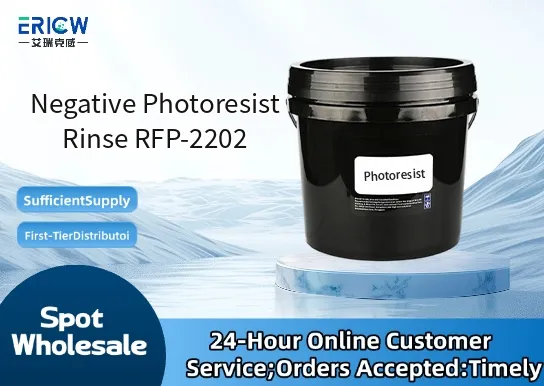
Optimized low-residue formulation for high-fidelity pattern retention after development.
Non-ionic surfactant system ensures uniform rinse performance without micro-foaming or surface tension instability.
Low volatility and controlled evaporation rate to minimize watermarking and drying defects on sensitive photoresist films.
Compatible with both aqueous and solvent-based negative photoresists, including Novolac and epoxy-based resins.
Free of halogenated solvents and heavy metals, supporting RoHS-compliant manufacturing processes.
Wafer-level photolithography in semiconductor front-end fabrication (0.35–1.0 µm feature sizes).
MEMS device patterning requiring high aspect-ratio resist profiles and minimal undercut.
Flat panel display (FPD) array substrate processing using thick-film negative resists.
Advanced packaging lithography, including redistribution layer (RDL) and fan-out wafer-level packaging (FOWLP).
Micro-optics and diffractive optical element (DOE) fabrication with sub-micron alignment accuracy.
| Chemical Type | Proprietary non-ionic aqueous rinse solution |
| Product Form | Clear, colorless liquid (ready-to-use) |
| Appearance | Homogeneous, free of particulates or phase separation |
| pH (25°C, 1% w/w aqueous dilution) | 6.8 – 7.2 |
| Density (25°C) | 1.01 – 1.03 g/cm³ |
| Primary Applications | Post-development rinse for negative-tone photoresists |
| Key Features | Low residue, non-corrosive, static-dissipative |
| Regulatory Compliance | RoHS 2015/863/EU compliant; REACH SVHC-free (as of latest update) |
| Common Compatible Systems | Suitability |
| TOK NLD-1000 Series Negative Resists | Highly Recommended – Validated for full process compatibility and defect reduction |
| Dow Electronic Materials XP-1000 Negative Resists | Recommended – Requires minor rinse time optimization (±5 sec) |
| JSR THB-151J / TMMR-PM Series | Suitable – Confirmed effective with standard spin-rinse parameters |
| Canon (formerly SCA) SNR series resists | Recommended – Compatible with single-chamber and multi-tank track systems |
Q1: What is the CAS Registry Number for RFP-2202?
A: RFP-2202 is a proprietary multi-component formulation; individual components are disclosed under NDA, and no single CAS number applies to the final product. Full ingredient disclosure is available upon execution of a CDA.
Q2: What is the recommended usage concentration and temperature range?
A: RFP-2202 is supplied as a ready-to-use solution. No dilution required. Optimal performance is achieved at 20–25°C; heating above 30°C is not recommended due to increased volatility risk.
Q3: How does RFP-2202 compare to generic IPA/water rinses in terms of residue control?
A: Unlike IPA/water mixtures, RFP-2202 eliminates organic residue via synergistic surfactant-assisted displacement and rapid, uniform drying—reducing post-rinse residue by >90% (per SEM/EDX analysis on Si wafers).
Q4: Is RFP-2202 subject to migration or leaching into underlying layers during rinse?
A: No measurable migration occurs under standard process conditions (≤30 sec dwell time, ≤500 rpm spin speed). Independent testing per JEDEC JESD22-A106 confirms no extractables detected in underlying SiO₂ or metal layers (LOD < 0.1 ng/cm²).
Contact With Us:
E-mail: wangxingqiang@ericwchem.com
Have a Questions? Call Us:
Add:
Building A1, Jiete Industrial Park, Huangpu District, Guangzhou City, Guangdong Province, China