English
 Español
 tiếng việt
 русский
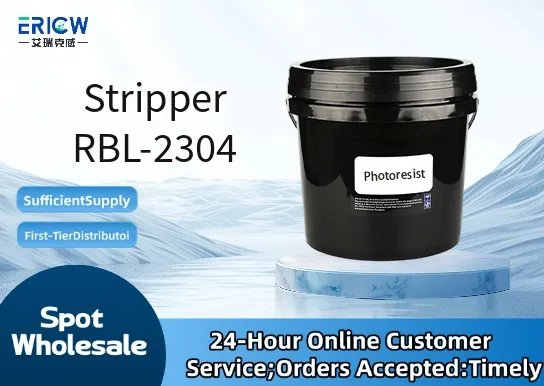
Highly selective removal of photoresist and etch residues without attacking underlying metal layers (Cu, Al, TiN) or low-k dielectrics.
Non-halogenated, aqueous-based formulation designed for environmental safety and reduced workplace hazards.
Stable performance across extended bath life (>72 hours at 50–60 °C) with minimal sludge formation.
Low surface tension and excellent wetting capability ensure uniform cleaning on high-aspect-ratio features.
Compatible with automated spray, immersion, and megasonic wafer cleaning equipment.
Post-etch residue removal in advanced logic and memory semiconductor fabrication.
Cleaning of copper interconnect structures after CMP or dry etch processes.
Photoresist stripping prior to metrology, inspection, or subsequent lithography steps.
Removal of BARC (bottom anti-reflective coating) and hard mask remnants in 28 nm to 5 nm node processes.
Back-end-of-line (BEOL) cleaning for advanced packaging substrates and fan-out wafers.
| Chemical Type | Aqueous alkaline amine-based formulation |
| Product Form | Liquid concentrate (ready-to-dilute) |
| Appearance | Clear, light amber liquid |
| pH (10% w/w aqueous solution, 25 °C) | 11.2 ± 0.3 |
| Density (25 °C) | 1.08–1.12 g/cm³ |
| Primary Applications | Photoresist & residue stripping in semiconductor front-end and BEOL |
| Key Features | Non-corrosive to aluminum, low-k dielectrics, and Cu; halogen-free |
| Regulatory Compliance | REACH compliant; RoHS 2015/863 Annex II compliant; no SVHCs above threshold |
| Common Compatible Systems | Suitability |
| SEZ® Aventex™ Spray Rinse System | Highly Recommended – Optimized flow rate and temperature control validated for full process window |
| Screen® SSW-3000 Immersion Tool | Recommended – Requires minor nozzle calibration; stable bath performance confirmed |
| Modutek® Teflon®-lined heated immersion tanks | Suitable – Compatible with PFA, PVDF, and quartz wet benches; no leaching observed |
| Ultrasonics (40–80 kHz, 50 °C) | Recommended – Enhances residue lift-off without cavitation damage to fragile structures |
Q1: What is the CAS Registry Number for Stripper RBL-2304?
A: Stripper RBL-2304 is a proprietary multi-component formulation; individual CAS numbers are not assigned to the final product. Key constituents include CAS 102-71-6 (triethanolamine), CAS 111-42-2 (diethylene glycol monobutyl ether), and CAS 126-30-7 (2-aminoethanol).
Q2: What is the recommended working concentration and temperature range?
A: Dilute 1:4 to 1:9 (v/v) with deionized water. Optimal operating temperature is 50–60 °C for immersion and 45–55 °C for spray applications. Higher temperatures may accelerate decomposition; lower temperatures reduce stripping rate.
Q3: How does RBL-2304 compare to traditional NMP-based strippers in terms of safety and residue clearance?
A: Unlike NMP-based strippers (CAS 872-50-4), RBL-2304 contains no reprotoxic solvents, exhibits lower dermal absorption, and eliminates NMP-related occupational exposure limits. Residue clearance performance matches or exceeds NMP systems on Cu/low-k stacks, with significantly reduced post-clean particle counts.
Q4: Is RBL-2304 subject to REACH authorization or listed under EU SCIP?
A: No. RBL-2304 contains no substances on the REACH Annex XIV Authorization List or SVHC Candidate List above 0.1% w/w. Full SCIP notification is completed for all customer-supplied articles per EU Directive 2018/851.
Q5: Does RBL-2304 cause metal ion migration or organic extractables in cleaned wafers?
A: No measurable Cu or Al migration is observed per SEM-EDS and TXRF analysis after standard rinse (DIW, 60 °C, 30 sec). GC-MS testing confirms <1 ppm total organic extractables (TOE) on Si wafers post-process.
Contact With Us:
E-mail: wangxingqiang@ericwchem.com
Have a Questions? Call Us:
Add:
Building A1, Jiete Industrial Park, Huangpu District, Guangzhou City, Guangdong Province, China