English
 Español
 tiếng việt
 русский
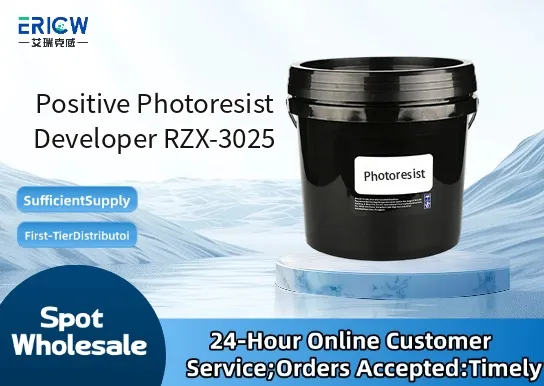
Optimized alkaline formulation for high-resolution development of g-line, i-line, and KrF photoresists.
Consistent performance across wide process windows—stable in temperature range of 20–25 °C and compatible with standard DI water dilution.
Low metal ion content (<10 ppb Na, K, Ca, Fe) to minimize contamination risk in semiconductor and MEMS fabrication.
Controlled dissolution rate enabling precise critical dimension (CD) control and excellent line edge roughness (LER) suppression.
Low foaming and high bath life—maintains activity for ≥120 L/m² throughput in automated track systems.
Semiconductor front-end-of-line (FEOL) lithography for 0.35–0.13 µm node IC manufacturing.
Advanced packaging processes including fan-out wafer-level packaging (FOWLP) and redistribution layer (RDL) patterning.
MEMS and sensor fabrication requiring high aspect ratio resist profiles and minimal undercut.
Flat panel display (FPD) array substrate patterning using i-line steppers and scanners.
LED and power device manufacturing with thick-film positive resists (e.g., AZ® nLOF series).
| Chemical Type | Aqueous tetramethylammonium hydroxide (TMAH) solution |
| Product Form | Liquid concentrate (2.38 wt% TMAH in ultra-pure deionized water) |
| Appearance | Clear, colorless, odorless liquid |
| pH (as supplied, 25 °C) | 13.4 ± 0.2 |
| Primary Applications | Positive-tone photolithography development for semiconductor, FPD, and advanced packaging |
| Key Features | Ultra-low particle count (<10 particles/mL @ ≥0.2 µm), sub-5 ppb metallic impurities |
| Benefits | Improved yield via reduced defects; compatible with high-speed spin development and puddle processes |
| Regulatory Compliance | REACH compliant; RoHS 2011/65/EU compliant; no SVHCs above threshold |
| Common Compatible Systems | Suitability |
| TOKYO ELECTRON CLEAN TRACK™ (ACT series) | Highly Recommended – Validated for full process integration with auto-dilution and bath monitoring |
| SCREEN Coater/Developer Systems (Sprint series) | Highly Recommended – Certified for CD uniformity <±1.5% 3σ across 300 mm wafers |
| DISCO DFL7360 / DFL7760 Litho Tracks | Recommended – Requires minor parameter tuning for optimal rinse efficiency |
| Generic manual spin coater + developer bench | Suitable – Validated for R&D and low-volume production with standardized 60-sec puddle time |
Q1: What is the CAS Registry Number for RZX-3025?
A: RZX-3025 is a proprietary aqueous formulation; its base active ingredient, tetramethylammonium hydroxide, has CAS No. 75-59-2. The complete product is assigned internal batch-specific traceability codes per ISO 9001 requirements.
Q2: What is the recommended working concentration and usage ratio?
A: Supplied as a ready-to-dilute concentrate. Standard working concentration is 2.38 wt% TMAH, achieved by diluting 1 part RZX-3025 with 9 parts ultra-pure DI water (18.2 MΩ·cm, <0.1 ppb Na). Do not use tap or filtered water.
Q3: How does RZX-3025 compare to standard 2.38% TMAH developers in terms of residue and microbridge formation?
A: RZX-3025 contains proprietary surfactant and chelating additives that reduce surface tension by ~25% and suppress cationic residue aggregation—demonstrated to lower microbridge defect density by >40% versus generic TMAH in KrF 150 nm line/space patterns.
Q4: Is RZX-3025 compliant with USP <661.2> or ISO 10993 for medical device lithography applications?
A: While not certified to USP <661.2> or ISO 10993, RZX-3025 meets all raw material purity criteria outlined in ISO 14644-1 Class 1 cleanroom grade and has passed extractables testing per ASTM E1763-19 (aqueous extraction at 70 °C for 24 h), showing <0.5 µg/cm² total organic extractables.
Contact With Us:
E-mail: wangxingqiang@ericwchem.com
Have a Questions? Call Us:
Add:
Building A1, Jiete Industrial Park, Huangpu District, Guangzhou City, Guangdong Province, China