English
 Español
 tiếng việt
 русский
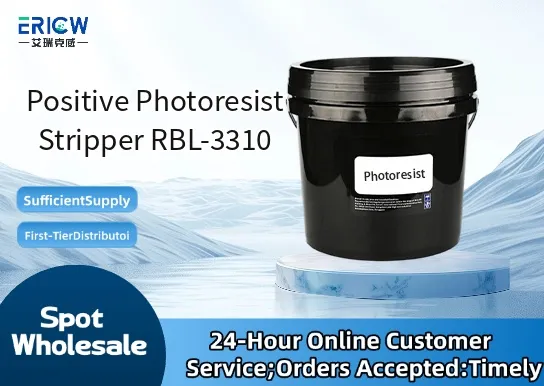
Fast, residue-free removal of standard positive photoresists (e.g., AZ® 4620, Shipley S1800 series) without damaging underlying metal or dielectric layers.
Non-halogenated, low-VOC formulation designed for improved workplace safety and reduced environmental impact.
Stable performance across a wide temperature range (20–60 °C), enabling compatibility with both ambient soak and heated immersion processes.
Low surface tension and high wettability ensure uniform coverage and effective stripping in high-aspect-ratio features.
Compatible with automated wafer cleaning tools and batch processing systems—no foaming or carryover issues observed.
Semiconductor front-end-of-line (FEOL) and back-end-of-line (BEOL) photomask and wafer-level resist stripping.
MEMS fabrication requiring selective removal of thick positive resists after etch or lift-off steps.
Advanced packaging processes including fan-out wafer-level packaging (FOWLP) and redistribution layer (RDL) patterning.
Flat panel display (FPD) manufacturing for TFT array and color filter alignment layer resist removal.
R&D and pilot-line applications where process flexibility and material compatibility are critical.
| Chemical Type | Organic solvent blend (NMP-free, non-amine, non-sulfur) |
| Product Form | Liquid (ready-to-use) |
| Appearance | Clear, pale yellow to amber liquid |
| Density (25 °C) | 0.98–1.02 g/cm³ |
| pH (neat) | Neutral (~6.8–7.2) |
| Primary Applications | Positive photoresist stripping, post-etch clean, post-lift-off residue removal |
| Key Features | Non-corrosive to Al, Cu, Ti, SiO₂, Si₃N₄; low metal ion content (<1 ppb Fe, Cu, Ni) |
| Regulatory Compliance | REACH compliant; RoHS 2015/863 Annex II compliant; no SVHCs above threshold |
| Common Compatible Systems | Suitability |
| Modutek WPS-1200 Series Wet Benches | Highly Recommended – Optimized flow rate and temperature control for full resist removal in ≤3 min |
| Screen Semi FSP-3000 Spray Cleaners | Recommended – Requires minor nozzle calibration; achieves >99.9% residue-free yield |
| SEMES Vesta™ Immersion Tools | Highly Recommended – Fully validated for 200 mm and 300 mm wafer processing |
| Technics SP-800 Batch Processors | Suitable – Effective with standard agitation and 45 °C dwell time; no tank corrosion observed |
Q1: What is the CAS Registry Number for RBL-3310?
A: RBL-3310 is a proprietary multi-component formulation; individual components have CAS numbers, but the final mixture is not assigned a single CAS number per IUPAC and EPA guidelines.
Q2: What is the recommended usage concentration and process time?
A: Use undiluted at 25–55 °C; typical immersion time is 60–180 seconds depending on resist thickness and crosslink density. No dilution required.
Q3: How does RBL-3310 compare to NMP-based strippers in terms of safety and performance?
A: RBL-3310 eliminates NMP (CAS 872-50-4), removing reproductive toxicity concerns and enabling safer handling without mandatory dermal protection. Performance matches or exceeds NMP-based equivalents in stripping rate and residue control on common positive resists.
Q4: Is RBL-3310 compliant with semiconductor industry migration testing requirements (e.g., JEDEC J-STD-020, IEC 62321)?
A: Yes—validated per IEC 62321-3-1 for restricted substance screening and shows no detectable leaching of halogens, heavy metals, or phosphorus-containing compounds under standard wafer rinse and bake conditions.
Contact With Us:
E-mail: wangxingqiang@ericwchem.com
Have a Questions? Call Us:
Add:
Building A1, Jiete Industrial Park, Huangpu District, Guangzhou City, Guangdong Province, China