English
 Español
 tiếng việt
 русский
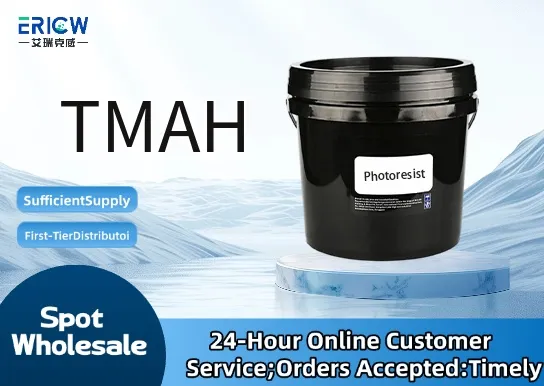
Highly selective silicon etchant for precise microfabrication of MEMS and semiconductor devices.
Non-oxidizing, anisotropic developer with excellent resolution and edge acuity in photolithography.
Water-soluble and stable across a broad pH range (pH 10–13), enabling consistent process control.
Low metal ion content (<1 ppb Na, K, Fe) to minimize contamination in high-purity fabrication environments.
Compatible with standard cleanroom handling protocols and stainless steel/PP/PTFE wet processing equipment.
Positive-tone photoresist development in advanced CMOS and DRAM manufacturing.
Anisotropic etching of silicon wafers for MEMS sensors, accelerometers, and microfluidic channels.
Surface cleaning and residue removal in post-etch and pre-deposition wafer preparation steps.
Microstructuring of silicon-on-insulator (SOI) substrates for photonics and NEMS applications.
Formulation component in high-performance electronic-grade developer concentrates.
| Chemical Type | Tetramethylammonium hydroxide monohydrate (CH₃)₄N⁺OH⁻·H₂O |
| Product Form | Aqueous solution (2.38 wt%, 5.0 wt%, 25.0 wt% available; also supplied as crystalline monohydrate) |
| Appearance | Clear, colorless liquid (solutions) or white crystalline solid (monohydrate) |
| Melting Point | 68–70 °C (monohydrate); solutions remain liquid at room temperature |
| Primary Applications | Semiconductor lithography development, silicon anisotropic etching, precision cleaning |
| Key Features | Non-volatile, non-oxidizing, low volatility, high thermal stability up to 120 °C |
| Benefits | Superior pattern fidelity, reduced undercut vs. KOH, improved process repeatability |
| Regulatory Compliance | REACH registered; compliant with SEMI C12 (high-purity chemicals) and ISO 9001 manufacturing standards |
| Common Compatible Systems | Suitability |
| Stainless Steel 316L Wet Benches | Highly Recommended – Excellent corrosion resistance above pH 10 |
| PP (Polypropylene) and PVDF Piping & Tanks | Highly Recommended – No swelling or degradation observed under standard use conditions |
| Quartz and Fused Silica Process Chambers | Recommended – Stable contact; avoid prolonged exposure >80 °C to prevent slow surface leaching |
| Standard Photolithography Track Systems (e.g., Tokyo Electron CLEAN TRACK) | Suitable – Fully compatible with dispense, puddle, and rinse modules when calibrated for viscosity and concentration |
Q1: What is the CAS Number for TMAH?
A: The CAS Registry Number for tetramethylammonium hydroxide monohydrate is 75-59-2.
Q2: What is the typical working concentration for silicon etching?
A: Standard etch concentrations range from 5 wt% to 25 wt% at 70–90 °C; etch rates vary from 0.3–1.2 µm/min depending on crystal orientation and temperature.
Q3: How does TMAH compare to KOH for silicon etching?
A: TMAH offers superior selectivity to silicon dioxide and silicon nitride, lower vapor pressure, reduced toxicity, and better compatibility with aluminum metallization layers compared to KOH.
Q4: Is TMAH subject to REACH or TSCA regulation?
A: Yes — TMAH is listed on the TSCA Inventory and fully REACH registered (EC No. 200-875-2); SDS and regulatory documentation are provided upon request.
Q5: Does TMAH migrate or extract into processed wafers during development?
A: No significant migration occurs under standard lithographic conditions; residual quaternary ammonium ions are effectively removed by DI water rinses and do not persist in final device structures per SEMI F57 testing protocols.
Contact With Us:
E-mail: wangxingqiang@ericwchem.com
Have a Questions? Call Us:
Add:
Building A1, Jiete Industrial Park, Huangpu District, Guangzhou City, Guangdong Province, China