English
 Español
 tiếng việt
 русский
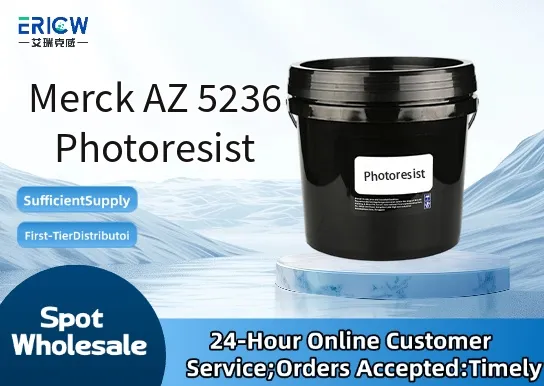
High-resolution positive-tone photoresist optimized for UV lithography at g-line (436 nm) and i-line (365 nm) wavelengths.
Excellent thermal stability and post-exposure bake (PEB) latitude, enabling robust process control in semiconductor and MEMS fabrication.
Superior adhesion to silicon, silicon dioxide, and metal substrates without requiring additional primers under standard processing conditions.
Low outgassing profile compatible with vacuum-based lithography tools and cleanroom environments classified ISO Class 5 or better.
Consistent batch-to-batch performance supported by Merck’s stringent quality control and traceable manufacturing documentation.
Semiconductor device manufacturing, including gate patterning and interconnect definition in CMOS processes.
Microelectromechanical systems (MEMS) fabrication requiring high aspect ratio features and mechanical stability during etch.
Flat panel display (FPD) photomask production and thin-film transistor (TFT) array patterning.
Advanced packaging applications such as redistribution layer (RDL) and via patterning in fan-out wafer-level packaging (FOWLP).
Research and development in nanofabrication labs utilizing contact and proximity aligners.
| Chemical Type | Novolac resin–based positive photoresist with diazonaphthoquinone (DNQ) photosensitizer |
| Product Form | Liquid solution in proprietary solvent blend (typically ethyl lactate and propylene glycol monomethyl ether acetate) |
| Appearance | Clear, pale yellow to amber homogeneous liquid |
| Viscosity (23 °C) | 2.8 – 3.2 cP (measured per ASTM D445) |
| Specific Gravity (20 °C) | 1.01 – 1.03 g/cm³ |
| Primary Applications | UV photolithography for microfabrication (g-line/i-line), mask making, and R&D prototyping |
| Key Features | High sensitivity (~40–60 mJ/cm² at i-line), good resolution down to 1.0 µm line/space, low standing wave effect |
| Regulatory Compliance | REACH compliant; RoHS 2011/65/EU conformant; no SVHCs above threshold per latest ECHA candidate list |
| Common Compatible Systems | Suitability |
| ASML PAS 5500 / 6000 series steppers | Highly Recommended – Validated for i-line exposure with standard focus/exposure calibration |
| Karlsruhe Institute of Technology (KIT) Mask Aligner MA6/BA6 | Highly Recommended – Optimized for contact/proximity mode with uniform thickness control |
| Canon FPA-3000 i-line stepper | Recommended – Requires minor dose adjustment; compatible with standard track integration |
| SVGL MicraStep 1000 | Suitable – Functional performance confirmed; recommended for R&D use with process qualification |
| Lab-scale spin coaters (e.g., Laurell WS-400B-6NPP/LITE) | Highly Recommended – Consistent film thickness (1.2–1.8 µm @ 3000 rpm) with minimal edge bead removal requirement |
Q1: What is the CAS Registry Number for Merck AZ 5236 Photoresist?
A: AZ 5236 is a proprietary formulated product; it does not have a single CAS number. Individual components are listed under their respective CAS numbers in the Safety Data Sheet (SDS), available upon request from Merck Technical Support.
Q2: What is the typical coating thickness and recommended spin speed range?
A: At 3000 rpm, nominal thickness is 1.4 ± 0.1 µm on silicon wafers; thickness can be adjusted from 0.8 µm (5000 rpm) to 2.2 µm (1000 rpm) using standard spin parameters and ambient humidity control (40–50% RH).
Q3: How does AZ 5236 compare to AZ 5214E in terms of resolution and etch resistance?
A: AZ 5236 offers higher resolution (≤1.0 µm vs. ~1.5 µm for AZ 5214E) and improved plasma etch resistance due to its higher novolac molecular weight and optimized DNQ loading; however, AZ 5214E retains superior lift-off capability.
Q4: Is AZ 5236 suitable for use in medical device manufacturing subject to ISO 10993 requirements?
A: AZ 5236 is not certified to ISO 10993. It is intended for microfabrication tooling and non-implantable device patterning only. For biocompatible applications, consult Merck’s dedicated Life Science portfolio and perform full extractables/leachables assessment.
Q5: Are there known migration or extraction concerns when AZ 5236 residues remain after development and hard bake?
A: Fully processed (post-hard-bake at 120 °C for 60 s) AZ 5236 films show negligible leaching in aqueous or mild organic solvents under standard environmental testing (per IEC 62321-7-2). Residual unexposed resist must be fully removed prior to device release or encapsulation.
Contact With Us:
E-mail: wangxingqiang@ericwchem.com
Have a Questions? Call Us:
Add:
Building A1, Jiete Industrial Park, Huangpu District, Guangzhou City, Guangdong Province, China