English
 Español
 tiếng việt
 русский
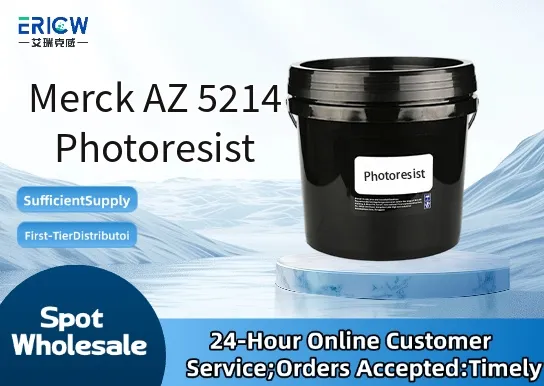
High-resolution positive-tone imaging capability with excellent contrast and line-edge roughness control.
Optimized for broadband (g/h/i-line) UV exposure systems, offering robust process latitude and reproducibility.
Good adhesion to silicon, silicon dioxide, and metal substrates without requiring additional primers in most standard processes.
Compatible with standard aqueous alkaline developers (e.g., 0.26 N TMAH), enabling high-throughput manufacturing.
Thermally stable post-bake profile supporting reliable pattern transfer during etch and lift-off processes.
Microelectronics fabrication — gate-level patterning in CMOS and analog IC processes.
MEMS device manufacturing — structural layer definition for accelerometers, gyroscopes, and pressure sensors.
Flat-panel display (FPD) production — TFT array patterning on glass substrates.
Advanced packaging — redistribution layer (RDL) and bump mask applications.
Research & development lithography — prototyping of microfluidic and photonic devices.
| Chemical Type | Novolac resin-based positive photoresist with diazonaphthoquinone (DNQ) photosensitizer |
| Product Form | Liquid, ready-to-use solution in ethyl lactate and propylene glycol monomethyl ether acetate (PGMEA) |
| Appearance | Clear, amber-colored homogeneous liquid |
| Viscosity (23 °C) | ~1.9 – 2.1 cP (as supplied) |
| Primary Applications | Broadband (g/h/i-line) lithography for sub-micron to 5 µm feature sizes |
| Key Features | High sensitivity (~40–60 mJ/cm² at i-line), low standing wave effect, minimal swelling in developer |
| Benefits | Reduced defect density, improved CD uniformity, compatibility with spin-coating and automated track systems |
| Regulatory Compliance | REACH compliant; RoHS 2011/65/EU applicable; no intentionally added SVHCs above threshold |
| Common Compatible Systems | Suitability |
| ASML PAS 5500 / XT series steppers | Highly Recommended – Validated for g/h/i-line exposure with standard illumination modes |
| Canon FPA-3000 i-line stepper | Highly Recommended – Optimized focus/exposure matrix available from Merck technical support |
| TOKYO ELECTRON CLEAN TRACK ACT series | Recommended – Fully supported coating, soft bake, and develop recipes |
| SVGL Micrascan III (broadband) | Suitable – Requires minor process tuning; compatible with standard proximity aligners |
Q1: What is the CAS Number for Merck AZ 5214 Photoresist?
A: AZ 5214 is a proprietary formulation; individual components have CAS numbers (e.g., novolac resin: 9003-35-4; DNQ: 84-58-2), but the final product is not assigned a single CAS number per IUPAC and regulatory guidelines for multicomponent mixtures.
Q2: What is the typical spin-coating thickness range and corresponding spin speed for AZ 5214?
A: At 3000 rpm, nominal thickness is ~1.4 ± 0.1 µm on silicon wafers; thickness can be adjusted from ~0.8 µm (4000 rpm) to ~2.2 µm (2000 rpm) using standard 2-inch to 8-inch spin coaters.
Q3: How does AZ 5214 compare to AZ 5214E or AZ 5214D variants?
A: AZ 5214 is the original formulation; AZ 5214E features enhanced thermal stability for demanding post-exposure bakes, while AZ 5214D offers reduced outgassing for vacuum-compatible lithography — all share identical base chemistry and compatibility profiles.
Q4: Does AZ 5214 comply with USP Class VI or ISO 10993 for biomedical device use?
A: No — AZ 5214 is not certified for implantable or direct patient-contact applications; it is designed for semiconductor and industrial microfabrication. For biomedical lithography, Merck recommends evaluating AZ nLOF series under ISO 10993-5 cytotoxicity screening protocols.
Q5: Are there known extractables or leachables from AZ 5214 after development and hard bake?
A: Residual solvent (PGMEA, ethyl lactate) and trace unreacted DNQ derivatives may be detected via GC-MS in aggressive extraction studies; full removal is achieved after standard 120 °C hard bake (30 min) and O₂ plasma descum — recommended for high-reliability applications.
Contact With Us:
E-mail: wangxingqiang@ericwchem.com
Have a Questions? Call Us:
Add:
Building A1, Jiete Industrial Park, Huangpu District, Guangzhou City, Guangdong Province, China