English
 Español
 tiếng việt
 русский
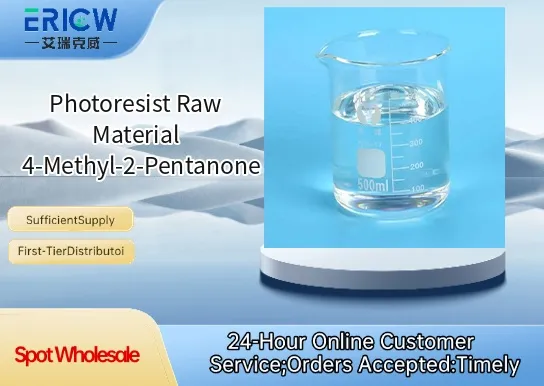
High-purity solvent with exceptional solvency power for photoacid generators (PAGs) and resin binders in advanced lithography formulations.
Low water miscibility and controlled evaporation rate—enabling uniform thin-film formation and reduced defect density in spin-coated resist layers.
Minimal residue after soft-bake, supporting high-resolution patterning down to sub-100 nm node applications.
Chemically stable under standard cleanroom handling conditions; non-reactive with common phenolic and acrylate-based resist polymers.
Low peroxide formation tendency during storage, enhancing shelf life and process consistency in high-volume semiconductor manufacturing.
Primary solvent in g-line (436 nm), i-line (365 nm), and deep UV (248 nm) positive-tone photoresists for IC fabrication.
Co-solvent component in chemically amplified resists (CARs) to optimize viscosity, coating uniformity, and post-apply bake performance.
Formulation ingredient in advanced EUV (13.5 nm) resist screening blends requiring low surface tension and high volatility control.
Process solvent in resist removers and strippers for post-etch residue cleaning in front-end-of-line (FEOL) integration.
Carrier medium for nanoparticle dispersion in hybrid organic-inorganic resist systems used in MEMS and advanced packaging lithography.
| Chemical Type | Methyl ketone (aliphatic aprotic solvent) |
| Product Form | Liquid, clear and colorless |
| Appearance | Clear, water-white liquid, free of suspended matter |
| Melting Point | −79 °C |
| Boiling Point (at 760 mmHg) | 117–119 °C |
| Density (20 °C) | 0.812–0.816 g/cm³ |
| Water Content (Karl Fischer) | ≤ 50 ppm |
| Residue on Evaporation | ≤ 10 ppm |
| Common Compatible Systems | Suitability |
| Novolac resin + diazonaphthoquinone (DNQ) formulations | Highly Recommended – Excellent dissolution contrast and film integrity |
| Poly(hydroxystyrene)-based chemically amplified resists (CARs) | Highly Recommended – Optimal PAG/resin solubility and low outgassing |
| Acrylic copolymer resists (e.g., MAA/MAA-tert-butyl ester) | Recommended – Requires minor formulation adjustment for viscosity control |
| Photoresist filtration systems (e.g., Teflon®-lined housings, 20 nm PTFE membranes) | Suitable – Non-reactive with fluoropolymer wetted parts and low particle generation |
Q1: What is the CAS Registry Number for 4-Methyl-2-pentanone?
A: The CAS number is 108-10-1.
Q2: What is the typical usage concentration in photoresist formulations?
A: It is commonly used at 75–92 wt% in final resist solutions, depending on resin molecular weight, solids content, and desired coating thickness.
Q3: How does 4-Methyl-2-pentanone compare to PGMEA in photoresist applications?
A: It offers faster evaporation than PGMEA (bp 146 °C), lower surface tension, and improved compatibility with hydrophobic PAGs—making it preferred for high-throughput immersion lithography and ultra-thin films.
Q4: Is this material compliant with SEMI S2 and REACH regulations?
A: Yes—manufactured under ISO 9001 and ISO 14001 systems; fully REACH registered (EC No. 203-552-8), and SEMI S2-compliant for occupational health and safety in microelectronics fabs.
Q5: Does 4-Methyl-2-pentanone exhibit extractable or leachable behavior in contact with resist-coated wafers during storage?
A: No significant migration or leaching occurs under standard nitrogen-purged wafer cassette storage at 22 °C; validated by GC-MS analysis of post-bake vapor condensates and wafer surface extracts.
Contact With Us:
E-mail: wangxingqiang@ericwchem.com
Have a Questions? Call Us:
Add:
Building A1, Jiete Industrial Park, Huangpu District, Guangzhou City, Guangdong Province, China