English
 Español
 tiếng việt
 русский
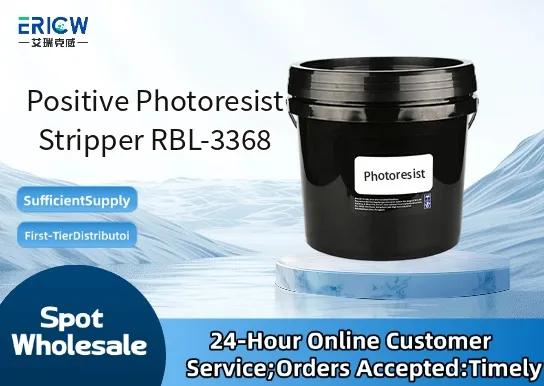
Fast and complete removal of standard positive photoresists (e.g., AZ® 4620, Shipley S1800 series) without substrate damage.
Non-corrosive formulation compatible with aluminum, copper, titanium, and silicon dioxide layers.
Low volatility and high thermal stability for consistent performance in batch and spray cleaning systems.
Water-rinseable residue profile — eliminates need for aggressive solvent post-rinses.
Formulated without halogenated solvents or NMP (N-Methyl-2-pyrrolidone), supporting safer workplace handling.
Semiconductor front-end-of-line (FEOL) and back-end-of-line (BEOL) photomask and wafer stripping.
MEMS device fabrication requiring high-fidelity resist removal prior to etch or deposition steps.
Flat panel display (FPD) manufacturing for TFT array patterning cleanup.
Advanced packaging processes including fan-out wafer-level packaging (FOWLP) and bump processing.
R&D and pilot-line applications where low-metal-ion contamination and reproducible kinetics are critical.
| Chemical Type | Alkaline aqueous-based blend with proprietary organic co-solvents |
| Product Form | Liquid concentrate (ready-to-use after dilution) |
| Appearance | Clear, pale yellow to amber liquid, no sediment or haze |
| pH (10% v/v aqueous solution, 25°C) | 12.4 ± 0.3 |
| Primary Applications | Stripping of novolac- and DNQ-based positive photoresists |
| Key Features | No NMP, no DMSO, no halogenated hydrocarbons; low VOC (<100 g/L) |
| Benefits | Reduced EHS risk, compatibility with stainless steel and polypropylene wet benches |
| Regulatory Compliance | REACH SVHC-free; compliant with RoHS 2015/863/EU Annex II |
| Common Compatible Systems | Suitability |
| Modutek Teflon®-lined batch immersion tanks | Highly Recommended – Stable performance up to 80°C with minimal evaporation loss |
| SEMITOOL / Lam Research spin-rinse-develop (SRD) tools | Recommended – Requires optimized dispense volume and dwell time per process recipe |
| Screen FSI ultrasonic cleaning platforms | Suitable – Effective at 45–60°C with 3–5 min dwell; verify nozzle compatibility |
| Applied Materials Aera™ track systems | Highly Recommended – Fully integrated into developer/strip modules with validated chemical delivery |
Q1: What is the CAS Registry Number for RBL-3368?
A: RBL-3368 is a proprietary multi-component formulation; individual CAS numbers are not assigned to the final product. Key constituents include sodium metasilicate pentahydrate (CAS 10213-79-3) and diethylene glycol monoethyl ether (CAS 111-90-0), listed on the full Safety Data Sheet (SDS).
Q2: What is the recommended working concentration and temperature range?
A: Use as a 1:1 to 1:3 dilution (v/v) with deionized water. Optimal stripping occurs at 60–75°C with 2–6 minutes dwell time, depending on resist thickness and crosslink density.
Q3: How does RBL-3368 compare to traditional amine-based strippers in terms of metal ion contamination?
A: RBL-3368 contains <1 ppb total Na⁺/K⁺/Ca²⁺/Mg²⁺ (ICP-MS tested), significantly lower than conventional monoethanolamine (MEA) or ethylenediamine (EDA) strippers, minimizing risk of gate oxide degradation in advanced nodes.
Q4: Is RBL-3368 suitable for use in environments requiring ISO 14644-1 Class 100 cleanrooms?
A: Yes — validated for particle generation ≤10 particles ≥0.2 µm per mL (per JIS B 9921:2019) when filtered through 0.1 µm PTFE membrane prior to use.
Contact With Us:
E-mail: wangxingqiang@ericwchem.com
Have a Questions? Call Us:
Add:
Building A1, Jiete Industrial Park, Huangpu District, Guangzhou City, Guangdong Province, China