English
 Español
 tiếng việt
 русский
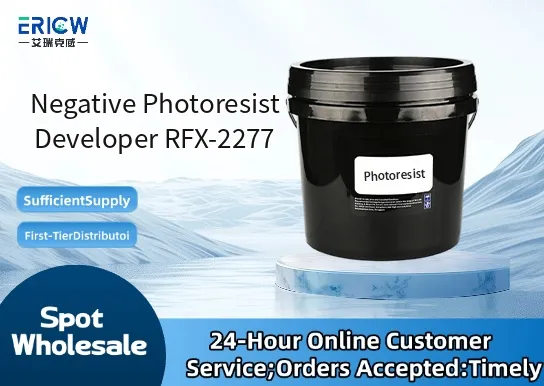
Optimized alkaline formulation for high-resolution development of standard negative-tone photoresists.
Consistent, low-foaming performance across automated track and batch processing systems.
Controlled dissolution kinetics enabling precise line-width control and minimal undercutting.
Low metal ion content (<10 ppb Na, K, Ca) to prevent contamination in microelectronics fabrication.
Stable shelf life (>18 months unopened) under ambient storage conditions (15–25°C).
Wafer-level photolithography in semiconductor front-end-of-line (FEOL) manufacturing.
MEMS device patterning requiring high aspect-ratio resist profiles.
Flat panel display (FPD) array substrate processing for TFT-LCD and OLED backplanes.
Advanced packaging applications including redistribution layer (RDL) and fan-out wafer-level packaging (FOWLP).
Microfluidic device fabrication using SU-8 and related epoxy-based negative resists.
| Chemical Type | Aqueous alkaline solution (tetramethylammonium hydroxide – TMAH based) |
| Product Form | Liquid concentrate (ready-to-dilute) |
| Appearance | Clear, colorless to pale yellow liquid |
| pH (1:10 dilution, 25°C) | 13.2 ± 0.3 |
| Density (25°C) | 1.02–1.04 g/cm³ |
| Primary Applications | Development of epoxy-based (e.g., SU-8), novolac-based, and acrylic negative photoresists |
| Key Features | Low volatility, non-oxidizing, compatible with stainless steel and polypropylene wet benches |
| Regulatory Compliance | REACH compliant; RoHS 2015/863 Annex II compliant; no SVHCs above threshold |
| Common Compatible Systems | Suitability |
| TOKYO ELECTRON CLEAN TRACK (ACT series) | Highly Recommended – Validated for full process integration with temperature and flow control |
| SCREEN Semiconductor Solutions (Coater/Developer systems) | Highly Recommended – Pre-qualified for SU-8 2000 and 3000 series development |
| SEMES D-Track Pro | Recommended – Requires minor nozzle calibration; stable throughput at 23°C ± 0.5°C |
| Manual spin-coater & immersion bath setups | Suitable – Effective with standardized 60-second development time and DI water rinse protocol |
Q1: What is the CAS Number for RFX-2277?
A: RFX-2277 is a proprietary multi-component formulation; it does not have a single CAS number. Its primary active ingredient, tetramethylammonium hydroxide (TMAH), carries CAS No. 75-59-2. Full compositional disclosure is available under NDA.
Q2: What is the recommended working concentration and development time?
A: Dilute 1 part RFX-2277 with 9 parts deionized water (10% v/v) for standard SU-8 processing. Typical development time ranges from 30–90 seconds at 23°C, depending on film thickness and exposure dose.
Q3: How does RFX-2277 compare to generic TMAH developers?
A: RFX-2277 includes proprietary surfactant and chelating additives that reduce surface tension by ~25%, improve resist edge acuity, and suppress micro-bridging—unachievable with standard 2.38% TMAH solutions.
Q4: Is RFX-2277 certified for use in ISO Class 5 cleanrooms?
A: Yes — lot-specific particle count data (per JIS B 9927) confirms ≤5 particles ≥0.5 µm per mL in filtered product (0.1 µm PTFE membrane). Certificate of Analysis provided with each shipment.
Q5: Does RFX-2277 exhibit leachable residues or extractables in post-develop rinse water?
A: No detectable organic extractables (by GC-MS, LOD <1 ppb) or ionic residues (by IC, LOD <0.1 ppm) are observed following standard DI rinse (≥30 sec, 2 L/min flow). Residual TMAH levels remain below 5 ppm — well within SEMI C33-0301 limits.
Contact With Us:
E-mail: wangxingqiang@ericwchem.com
Have a Questions? Call Us:
Add:
Building A1, Jiete Industrial Park, Huangpu District, Guangzhou City, Guangdong Province, China