English
 Español
 tiếng việt
 русский
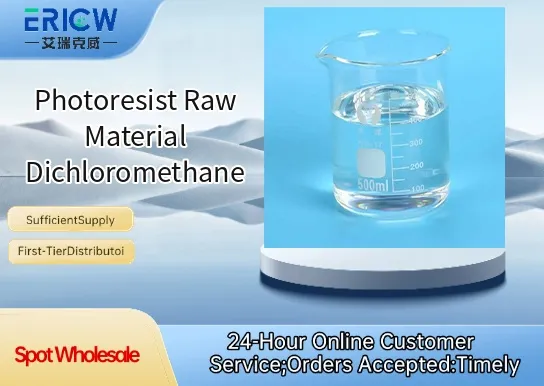
Ultra-high purity (≥99.95%) optimized for photolithography processes to minimize particle generation and residue formation.
Low water content (<50 ppm) ensures consistent photoresist dissolution kinetics and prevents interfacial defects during spin-coating.
Controlled trace metal impurities (Fe, Na, K < 10 ppb each) critical for semiconductor-grade microfabrication yield.
Volatile yet thermally stable profile enables rapid, residue-free removal in cleanroom-compatible drying steps.
Batch-to-batch reproducibility certified per ISO 9001 and SEMI S2/S8 standards for high-precision lithography.
Primary solvent for positive and negative tone photoresist formulations in advanced semiconductor manufacturing (≤28 nm nodes).
Diluent and rinse agent in wafer-level photolithography for MEMS and CMOS image sensor fabrication.
Carrier medium for photoacid generator (PAG) and polymer resin blending in EUV and DUV resist systems.
Cleaning component in post-develop inspection (PDI) and pre-etch solvent rinses for defect reduction.
Process fluid in roll-to-roll (R2R) flexible electronics patterning where low boiling point enables rapid solvent recovery.
| Chemical Type | Organic chlorinated solvent |
| Product Form | Clear, colorless liquid |
| Appearance | Transparent, free of suspended particles or turbidity |
| Melting Point | −96.7 °C |
| Boiling Point | 39.6 °C at 760 mmHg |
| Density (20 °C) | 1.325–1.330 g/cm³ |
| Water Content | ≤50 ppm (by Karl Fischer titration) |
| Residue on Evaporation | ≤1 ppm (at 105 °C, 1 hr) |
| Common Compatible Systems | Suitability |
| Acrylic-based positive photoresists (e.g., AZ® series) | Highly Recommended – Excellent solubility and film uniformity; no phase separation observed. |
| Chemically amplified resists (CARs) with PAGs (e.g., t-BOC, sulfonium salts) | Highly Recommended – Non-reactive with acid generators; preserves thermal stability during storage. |
| Novolac/DNQ-based negative resists | Recommended – Effective dissolution enhancer; requires controlled evaporation rate management. |
| Spin coaters (e.g., SUSS MicroTec, Tokyo Electron) | Highly Recommended – Fully compatible with stainless steel and fluoropolymer fluid paths; no swelling or degradation. |
Q1: What is the CAS number for this dichloromethane grade?
A: The CAS Registry Number is 75-09-2. This refers specifically to the ultra-high-purity semiconductor-grade material meeting ASTM D5117 and SEMI C37 specifications.
Q2: Can it be used directly as a photoresist diluent without further purification?
A: Yes — this grade is supplied filtered to ≤0.05 µm and packaged under nitrogen in double-contained fluorinated HDPE bottles, ready for direct use in Class 100 cleanrooms.
Q3: How does it compare to acetone or PGMEA in photoresist processing?
A: Unlike acetone (higher volatility, lower selectivity) or PGMEA (higher boiling point, slower drying), dichloromethane offers balanced evaporation kinetics, superior resin solvency for low-MW polymers, and minimal swelling of underlying organic layers.
Q4: Is it compliant with REACH, RoHS, and US EPA TSCA regulations?
A: Yes — fully compliant with REACH SVHC-free declaration, RoHS Annex II (exempted under Category 11 for industrial use), and TSCA Inventory listing. SDS and regulatory dossiers available upon request.
Q5: Does dichloromethane migrate into underlying dielectric layers during soft bake?
A: No significant migration occurs under standard lithography conditions (soft bake ≤90 °C, ≤60 sec). Its high volatility ensures near-complete removal prior to crosslinking, validated by TOF-SIMS depth profiling per SEMI D35.
Contact With Us:
E-mail: wangxingqiang@ericwchem.com
Have a Questions? Call Us:
Add:
Building A1, Jiete Industrial Park, Huangpu District, Guangzhou City, Guangdong Province, China