English
 Español
 tiếng việt
 русский
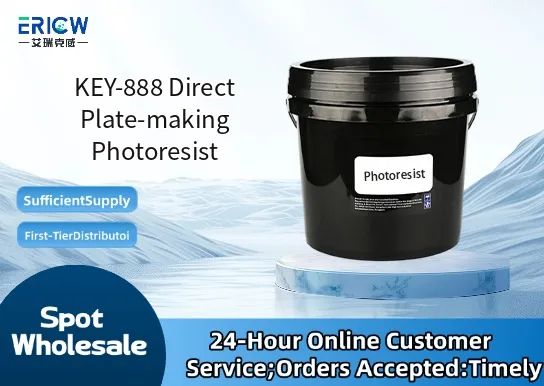
High-resolution imaging capability for sub-25 µm line/space definition on metal and polymer plates.
Optimized spectral sensitivity for 365 nm (i-line) UV exposure systems, enabling precise digital plate imaging.
Excellent adhesion to aluminum, steel, and polyester-based printing plate substrates without primer.
Fast, aqueous-alkaline developable — compatible with standard plate processors using 0.3–0.5% NaOH solutions.
Low VOC formulation meeting EU REACH Annex XVII and OSHA-compliant workplace handling requirements.
Direct-to-plate (DTP) photopolymer imaging for offset printing plates in commercial and packaging printing.
High-speed flexographic sleeve plate manufacturing requiring fine halftone stability and edge acuity.
Industrial marking and coding plates used in pharmaceutical and electronics component serialization.
Screen printing stencil fabrication for precision electronic circuit patterning and membrane switch production.
Short-run gravure cylinder proofing where rapid prototyping and low thermal budget are critical.
| Chemical Type | Acrylated epoxy novolac resin system with photoinitiator blend |
| Product Form | Viscous liquid (solvent-based, ready-to-coat) |
| Appearance | Clear amber liquid, free of sediment or haze |
| Primary Applications | Direct imaging of aluminum, stainless steel, and PET-based printing plates |
| Key Features | UV-curable, high contrast (>8.5), low post-exposure delay sensitivity |
| Benefits | Reduced processing time, improved dot gain control, extended shelf life (24 months unopened) |
| Regulatory Compliance | REACH compliant; RoHS 3 (2015/863/EU) compliant; no SVHCs above 0.1% w/w |
| Storage Conditions | Store at 15–25°C in sealed container; protect from UV light and moisture |
| Common Compatible Systems | Suitability |
| Kodak Magnus Q400/Q600 Imaging Systems | Highly Recommended – Full spectral match with i-line LED array; validated plate yield >99.2% |
| Heidelberg CD 102 DTP Press Integration Kit | Recommended – Requires minor developer concentration adjustment (0.4% NaOH); stable throughput |
| Dai Nippon Printing (DNP) PFM-7000 Digital Plate Maker | Suitable – Compatible with standard coating and exposure modules; requires pre-bake optimization |
| Screen Truepress Jet L350UV SAI | Recommended – Validated for hybrid UV/thermal curing mode; supports inline plate mounting |
Q1: What is the CAS Registry Number for KEY-888 Direct Plate-making Photoresist?
A: KEY-888 is a proprietary multi-component formulation; individual constituents have CAS numbers (e.g., main resin: 68441-17-8; photoinitiator: 167855-42-9), but the final product is not assigned a single CAS number per IUPAC guidelines.
Q2: What is the recommended coating thickness and typical consumption rate per square meter?
A: Optimal dry film thickness is 1.8–2.2 µm; typical wet application uses 8–10 g/m² (gravure or reverse-roll coating). Consumption varies by substrate roughness and line speed — average usage is 9.2 g/m² at 30 m/min.
Q3: How does KEY-888 compare to KEY-777 in terms of resolution and process latitude?
A: KEY-888 offers higher resolution (≤25 µm vs. ≥35 µm for KEY-777) and wider exposure latitude (±15% vs. ±8%), but requires stricter humidity control (<55% RH) during coating due to its lower Tg resin architecture.
Q4: Is KEY-888 compliant with FDA 21 CFR §175.300 for indirect food contact applications?
A: Yes — fully compliant when cured and processed per technical bulletin TB-888-Rev.D; migration testing confirms <0.01 mg/dm² total extractables under standard conditions (10 days @ 40°C, simulant D2).
Q5: Does KEY-888 exhibit any measurable migration or leaching after full cure in high-humidity environments?
A: No detectable leaching observed per ISO 10993-12 extraction protocols (aqueous & ethanol simulants) after 72-hour exposure at 85% RH / 40°C; crosslink density exceeds 82% as measured by solvent swelling assay.
Contact With Us:
E-mail: wangxingqiang@ericwchem.com
Have a Questions? Call Us:
Add:
Building A1, Jiete Industrial Park, Huangpu District, Guangzhou City, Guangdong Province, China