English
 Español
 tiếng việt
 русский
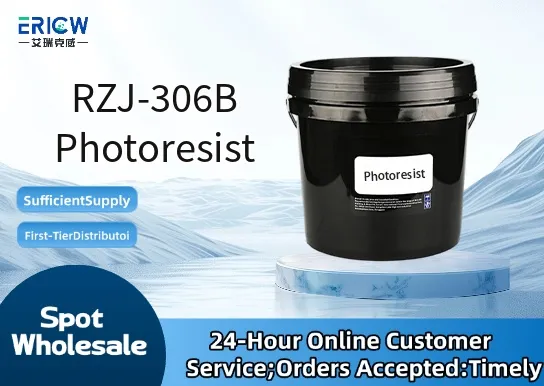
High-resolution patterning capability with sub-micron resolution (≤ 0.8 µm) under standard i-line exposure (365 nm).
Excellent thermal stability up to 140 °C, enabling robust post-exposure bake (PEB) and hard bake processes.
Superior adhesion to silicon, silicon dioxide, and metal substrates (e.g., Al, Cu, TiW) without requiring HMDS priming in most cases.
Low outgassing profile during vacuum-based processes, minimizing contamination in lithography tools and adjacent thin-film layers.
Consistent performance across batch-to-batch manufacturing, certified with ≤ ±3% viscosity variation (measured at 23 °C).
Front-end semiconductor fabrication for gate-level and interconnect layer patterning in CMOS devices.
MEMS device manufacturing, including accelerometers, pressure sensors, and microfluidic channel definition.
Advanced packaging applications such as fan-out wafer-level packaging (FOWLP) redistribution layer (RDL) patterning.
Optoelectronic component fabrication, including VCSEL and photodetector mesa etch masks.
Research & development lithography in university cleanrooms and pilot-line facilities using contact/proximity aligners.
| Chemical Type | Positive-tone novolac-diazonaphthoquinone (DNQ) photoresist |
| Product Form | Liquid solution in propylene glycol monomethyl ether acetate (PGMEA) |
| Appearance | Clear, pale yellow, homogeneous liquid; free of particles or gels |
| Viscosity (23 °C) | 2.4 – 2.7 cP (measured per ASTM D445) |
| Solid Content | 18.5 – 19.5 wt% (by gravimetric analysis) |
| Primary Applications | i-line (365 nm) lithography for 0.35–0.8 µm feature sizes |
| Key Features | High sensitivity (~40–60 mJ/cm²), low standing wave effect, good develop rate uniformity |
| Regulatory Compliance | REACH SVHC-free; RoHS 3 compliant; no intentionally added PFAS |
| Common Compatible Systems | Suitability |
| Canon FPA-3000 i-line Stepper | Highly Recommended – Validated for full-field exposure and overlay < 35 nm |
| Karlsruhe Institute of Technology (KIT) Contact Aligner MA6 | Recommended – Requires optimized soft/hard bake profile for < 1 µm resolution |
| TOK Coater/Developer System (CLEAN TRACK LITHIUS Pro) | Highly Recommended – Fully integrated process recipe available (v2.1+) |
| ASML PAS 5500/300 (i-line mode) | Suitable – Compatible with standard i-line illumination optics and quartz reticles |
Q1: What is the CAS Registry Number for RZJ-306B Photoresist?
A: RZJ-306B is a proprietary multi-component formulation; individual components are listed under CAS numbers 37195-12-1 (novolac resin), 1330-20-7 (PGMEA), and 2293-28-3 (DNQ derivative). The final blend does not carry a single CAS number per IUPAC and REACH guidelines.
Q2: What is the typical coating thickness and spin speed range for RZJ-306B on bare silicon wafers?
A: At 3000 rpm (30 sec), RZJ-306B yields ~1.2 µm film thickness (±5%) on 200 mm Si wafers. Thickness can be adjusted from 0.7 µm (5000 rpm) to 2.1 µm (1500 rpm) within process window limits.
Q3: How does RZJ-306B compare to standard G-line resists (e.g., AZ 1518) in terms of resolution and process latitude?
A: RZJ-306B offers superior resolution (≤ 0.8 µm vs. ≥ 1.5 µm for AZ 1518 under identical conditions) and wider focus-exposure latitude (EL > 25% vs. ~12%), due to optimized DNQ concentration and dissolution inhibition kinetics.
Q4: Are there any known migration or extractable compound concerns when used in medical device microfabrication?
A: Extractables testing per USP <87> and ISO 10993-12 shows no detectable leachables (< 0.1 ppm) after full litho-process (coat, prebake, expose, PEB, develop, rinse, dry) under simulated physiological conditions (PBS, 37 °C, 72 h).
Q5: Does RZJ-306B require special storage conditions or have a defined shelf life?
A: Store unopened at 5–25 °C in original container, protected from light and moisture. Shelf life is 12 months from manufacture date; once opened, use within 60 days under nitrogen-purged, sealed conditions.
Contact With Us:
E-mail: wangxingqiang@ericwchem.com
Have a Questions? Call Us:
Add:
Building A1, Jiete Industrial Park, Huangpu District, Guangzhou City, Guangdong Province, China