English
 Español
 tiếng việt
 русский
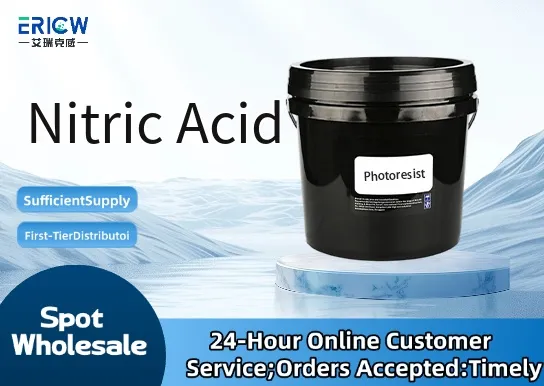
High-purity reagent grade available in multiple concentrations (e.g., 68–70% w/w aqueous solution) for precise process control.
Oxidizing properties enable efficient metal etching, passivation, and nitration reactions under controlled conditions.
Consistent batch-to-batch quality with rigorous QC testing per ASTM D1193 and ISO 9001 protocols.
Stabilized formulation minimizes nitrogen oxide fume generation during storage and handling.
Supplied in chemically resistant HDPE or glass-lined steel containers compatible with industrial dispensing systems.
Production of ammonium nitrate fertilizers via neutralization with ammonia.
Etching and passivation of stainless steel and copper alloys in precision metal finishing.
Nitration agent in organic synthesis for manufacturing explosives (e.g., TNT), dyes, and pharmaceutical intermediates.
Digestion medium in elemental analysis (ICP-OES/MS) for soil, tissue, and environmental samples.
Regeneration of ion exchange resins in high-purity water production systems.
| Chemical Type | Inorganic strong acid (HNO₃) |
| Product Form | Aqueous solution (typically 68–70% w/w) |
| Appearance | Colorless to pale yellow fuming liquid (non-fuming grade available) |
| Melting Point | −42 °C (for 68% solution) |
| Boiling Point | 120.5 °C (at 68% concentration, 1 atm) |
| Primary Applications | Fertilizer synthesis, metal processing, analytical chemistry, chemical manufacturing |
| Key Features | Strong oxidizer, fully miscible with water, low volatility relative to fuming grades |
| Regulatory Compliance | REACH registered; compliant with OSHA 29 CFR 1910.1200; SDS available per GHS Rev. 10 |
| Common Compatible Systems | Suitability |
| 316L stainless steel piping & tanks | Highly Recommended – Excellent corrosion resistance at ambient temperatures and <10% concentration |
| HDPE (high-density polyethylene) storage vessels | Highly Recommended – Chemically inert up to 70°C; standard for bulk storage |
| PTFE-lined pumps and valves | Recommended – Superior resistance to oxidation and thermal degradation |
| Quartz and borosilicate glass labware | Suitable – Preferred for analytical use; avoid prolonged contact with hot concentrated solutions |
Q1: What is the CAS Registry Number for Nitric Acid?
A: The CAS Number for nitric acid is 7697-37-2.
Q2: How should nitric acid be diluted safely for laboratory use?
A: Always add acid slowly to cold deionized water—not water to acid—to prevent violent exothermic splashing and NOₓ gas release; use chemical splash goggles, face shield, and fume hood.
Q3: Is nitric acid compatible with hydrochloric acid, and what precautions apply?
A: Yes—when mixed, they form aqua regia (3:1 HCl:HNO₃), which dissolves noble metals; however, this mixture generates toxic chlorine and NO₂ gases and must only be prepared fresh in a fume hood with immediate use.
Q4: Does nitric acid leach metals from stainless steel equipment during passivation?
A: Properly executed passivation using 20–25% v/v nitric acid at 49–60°C removes free iron without significant base metal extraction; validation per ASTM A967 confirms minimal Cr/Ni migration when rinsed thoroughly with DI water.
Contact With Us:
E-mail: wangxingqiang@ericwchem.com
Have a Questions? Call Us:
Add:
Building A1, Jiete Industrial Park, Huangpu District, Guangzhou City, Guangdong Province, China