English
 Español
 tiếng việt
 русский
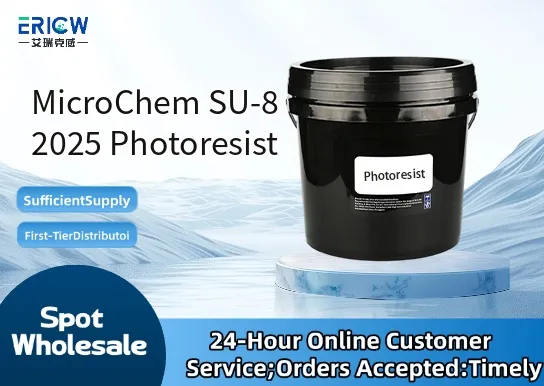
High-resolution negative-tone photoresist with sub-micron lithographic capability (down to 0.5 µm line/space).
Excellent thermal stability and chemical resistance post-bake (up to 200 °C).
Low outgassing formulation optimized for vacuum-compatible MEMS and microfluidic fabrication.
Consistent viscosity and shelf life (≥12 months at 4 °C, unopened).
UV-sensitive epoxy-based chemistry enabling robust crosslinking under standard i-line (365 nm) exposure.
MEMS device fabrication including accelerometers, gyroscopes, and pressure sensors.
Microfluidic chip patterning for lab-on-a-chip (LOC) and organ-on-a-chip platforms.
3D microstructures for biomedical scaffolds and micro-optical components.
Stencils and lift-off masks in thin-film metallization processes.
Permanent passivation layers in harsh-environment electronic packaging.
| Chemical Type | Epoxy novolac-based negative-tone photoresist |
| Product Form | Ready-to-use liquid solution (solvent: gamma-butyrolactone) |
| Appearance | Clear, pale yellow viscous liquid |
| Viscosity (25 °C) | 2500 ± 200 cP (measured per ASTM D2196) |
| Primary Applications | High-aspect-ratio photolithography (1:5–1:10), permanent structural layer |
| Key Features | Deep UV (i-line) sensitivity, low shrinkage (<2%), high adhesion to Si, SiO₂, and metal substrates |
| Benefits | Reduced process steps vs. multi-layer resists; eliminates need for post-development hard bake in many applications |
| Regulatory Compliance | REACH SVHC-free; RoHS 2015/863 compliant; no intentionally added PFAS |
| Common Compatible Systems | Suitability |
| Karl Suss MA6 / BA6 Mask Aligners | Highly Recommended – Optimized exposure dose and alignment protocols validated |
| Canon PLA-500 Series Steppers | Recommended – Requires minor focus offset calibration for 2025 formulation |
| SVGL MicraScan III (i-line) | Recommended – Compatible with standard quartz masks and immersion cooling |
| Spin Coaters (Laurell WS-650, Headway EC301) | Suitable – Verified uniformity ≥95% across 100–200 mm wafers |
Q1: What is the CAS Registry Number for MicroChem SU-8 2025 Photoresist?
A: The CAS number applies to the base resin system: 137141-54-7 (SU-8 epoxy novolac copolymer). Full formulation is proprietary and assigned internal batch ID; SDS lists all reportable components separately.
Q2: What is the typical spin-coating thickness range and corresponding spin speed for SU-8 2025 on silicon wafers?
A: At 3000 rpm, achieves ~25 µm thickness (±1.5 µm); 1000 rpm yields ~75 µm; thickness scales predictably per manufacturer’s spin curve data (provided with each lot).
Q3: How does SU-8 2025 differ from legacy SU-8 2000 series resists in processing behavior?
A: SU-8 2025 features refined solvent balance for reduced edge bead formation and improved film uniformity; exhibits ~12% lower post-exposure delay (PED) sensitivity and enhanced adhesion on Ti/Pt metallizations without HMDS priming.
Q4: Is SU-8 2025 suitable for ISO 10993 or USP Class VI biocompatibility testing?
A: SU-8 2025 is not pre-certified for biological evaluation; however, it meets raw material purity criteria required for extractables testing (per ISO 10993-12). End-user validation of leachables in final device configuration is mandatory.
Q5: Are there known migration concerns when SU-8 2025 is used in contact with aqueous or organic solvents in microfluidic devices?
A: Fully post-baked SU-8 2025 (>1 min @ 200 °C) shows negligible extractables in HPLC-grade water, PBS, and 70% ethanol per ICH Q5C testing; long-term exposure to strong acids/bases (>1 M) is not recommended without application-specific validation.
Contact With Us:
E-mail: wangxingqiang@ericwchem.com
Have a Questions? Call Us:
Add:
Building A1, Jiete Industrial Park, Huangpu District, Guangzhou City, Guangdong Province, China