English
 Español
 tiếng việt
 русский
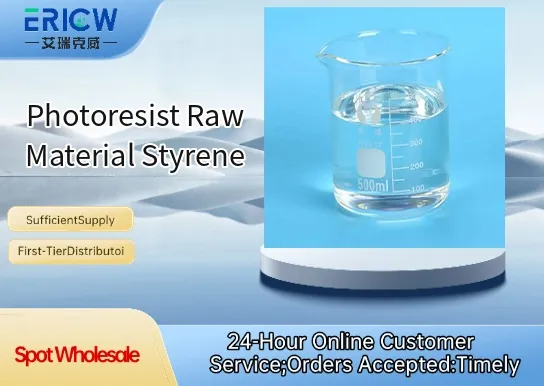
High-purity monomeric styrene (≥99.9%) optimized for photoresist polymer synthesis with minimal inhibiting impurities.
Low peroxide content (<5 ppm) to ensure consistent free-radical polymerization kinetics in resist resin formulation.
Controlled inhibitor level (4-methyl-2,6-di-tert-butylphenol, 10–15 ppm) for safe handling and extended shelf life without compromising reactivity.
Ultra-low ionic residue (Na⁺ <0.1 ppm, Cl⁻ <0.05 ppm) to prevent pattern defects and metal contamination in semiconductor lithography.
Batch-to-batch reproducibility certified via GC-MS and ICP-MS analysis, supporting qualification in high-volume manufacturing environments.
Synthesis of styrene-based copolymer resins (e.g., styrene/maleic anhydride, styrene/acrylic acid) for positive-tone deep-UV (248 nm) photoresists.
Monomer feedstock in the production of chemical amplification resist (CAR) base polymers requiring aromatic pendant groups for etch resistance.
Co-monomer in acrylic-styrene hybrid resins used in advanced packaging lithography (e.g., fan-out wafer-level packaging).
Building block for polyhydroxystyrene (PHS) precursor routes via post-polymerization sulfonation or hydrolysis.
Functional monomer in resist formulations targeting improved adhesion to low-k dielectrics (e.g., SiCOH) and copper interconnects.
| Chemical Type | Aromatic vinyl monomer |
| Product Form | Liquid (clear, colorless) |
| Appearance | Clear, water-white liquid; no visible particulates or haze |
| Melting Point | −30 °C |
| Boiling Point (at 760 mmHg) | 145 °C |
| Primary Applications | Photoresist resin synthesis, semiconductor lithography materials |
| Key Features | Ultra-high purity, low metals, controlled inhibitor, low peroxides |
| Regulatory Compliance | REACH registered; RoHS compliant; non-REACH SVHC candidate (as of latest ECHA update) |
| Common Compatible Systems | Suitability |
| Styrene/Maleic Anhydride (SMA) Copolymerization System | Highly Recommended – Proven compatibility with free-radical initiators (e.g., AIBN, V-70) under nitrogen blanket. |
| Acrylic-Styrene Solution Polymerization (in PGMEA/Ethyl Lactate) | Highly Recommended – Fully miscible; enables homogeneous resin formation without phase separation. |
| Chemical Amplification Resist (CAR) Synthesis Platform | Recommended – Requires post-polymerization functionalization (e.g., tert-butoxycarbonyl protection); validated for PAG integration. |
| Industrial Bulk Polymerization Reactors (e.g., CSTR, loop reactors) | Suitable – Compatible with stainless steel 316L and glass-lined equipment; no corrosion concerns under standard handling conditions. |
Q1: What is the CAS Number for Photoresist Raw Material Styrene?
A: The CAS Registry Number is 100-42-5. Our photoresist-grade material meets ASTM D2824 specifications with additional semiconductor-grade purification.
Q2: What is the typical usage concentration in photoresist resin synthesis?
A: In copolymer resins, styrene typically constitutes 20–60 mol% depending on target Tg, etch resistance, and dissolution rate; exact ratios are formulation-specific and require DOE optimization.
Q3: How does photoresist-grade styrene differ from technical-grade styrene?
A: Photoresist-grade styrene undergoes additional fractional distillation, chelation treatment, and sub-micron filtration to reduce metals (<0.5 ppm total), peroxides (<5 ppm), and carbonyl impurities (<10 ppm) — critical for lithographic defect control.
Q4: Is this material compliant with semiconductor industry migration requirements (e.g., SEMI S2/S8, JEDEC JESD22-A108)?
A: Yes — certified for low extractables in IPA and PGMEA solvents per SEMI C17; total volatile organic extractables <100 ppb under standardized leaching protocols.
Contact With Us:
E-mail: wangxingqiang@ericwchem.com
Have a Questions? Call Us:
Add:
Building A1, Jiete Industrial Park, Huangpu District, Guangzhou City, Guangdong Province, China