English
 Español
 tiếng việt
 русский
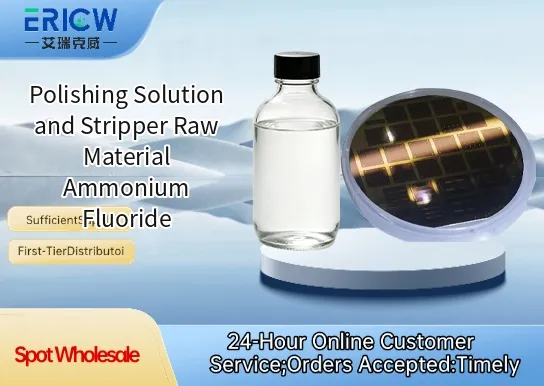
Highly effective etchant for silicon dioxide (SiO₂) and silicon nitride (Si₃N₄) in precision semiconductor and optical polishing processes.
Controlled dissolution kinetics enabling uniform material removal without undercutting or surface pitting.
Low volatility and stable aqueous solubility, supporting consistent formulation performance in industrial stripper and polishing solutions.
Compatible with common chelating agents and corrosion inhibitors for enhanced process control and equipment protection.
Available in high-purity grades (≥98.0% NH₄F) meeting stringent semiconductor-grade raw material specifications.
Silicon wafer surface preparation prior to epitaxial growth or thin-film deposition.
Removal of native oxide layers during microelectromechanical systems (MEMS) fabrication.
Optical glass and fused silica lens cleaning and anti-reflective coating stripping.
Etching component in chemical mechanical planarization (CMP) slurries for advanced logic and memory devices.
Pre-treatment agent for metal oxide substrates in photovoltaic cell manufacturing.
| Chemical Type | Inorganic ammonium salt, weak acid source of fluoride ions |
| Product Form | White crystalline powder (anhydrous) |
| Appearance | Free-flowing, odorless white crystals or granules |
| Melting Point | 125–126 °C (decomposes) |
| Primary Applications | Raw material for semiconductor polishing solutions, oxide strippers, and surface conditioning formulations |
| Key Features | Controlled F⁻ release, low heavy metal impurities (≤10 ppm total metals), low moisture content (≤0.5% w/w) |
| Benefits | Enables reproducible etch rates, minimizes residue formation, supports GMP-compliant manufacturing |
| Regulatory Compliance | REACH registered; SDS available; compliant with SEMI C1–2013 purity standards for electronic chemicals |
| Common Compatible Systems | Suitability |
| Aqueous-based CMP slurries (e.g., SiO₂ colloidal dispersions) | Highly Recommended – Stable dispersion with minimal pH drift; enhances oxide removal selectivity |
| Acidic stripping formulations (e.g., HF/NH₄F buffered mixtures) | Highly Recommended – Provides buffering capacity and controlled fluoride activity |
| Stainless steel and polypropylene wet processing equipment | Recommended – Non-corrosive to standard semiconductor tool materials when properly diluted and monitored |
| Deionized water rinse systems | Suitable – Fully soluble and rinsable; low residue risk under standard cleanroom rinse protocols |
Q1: What is the CAS Number for Ammonium Fluoride used in polishing and stripping applications?
A: The CAS Number is 12125-01-8. This refers specifically to the anhydrous form widely adopted as a raw material in electronic-grade formulations.
Q2: How does Ammonium Fluoride compare to Hydrofluoric Acid (HF) in terms of safety and process control?
A: Ammonium Fluoride offers significantly lower vapor pressure and reduced dermal penetration risk compared to HF. Its buffering action provides more predictable etch rates and easier pH management in formulated solutions.
Q3: Is Ammonium Fluoride subject to export controls or special handling certifications?
A: Yes — it is classified under EAR99 but may require export authorization depending on destination and end-use. It is listed in the EU Dual-Use Regulation Annex I (Category 1) due to its application in semiconductor manufacturing equipment.
Q4: Can Ammonium Fluoride migrate into final device layers, and how is extractable fluoride quantified?
A: Residual fluoride migration is mitigated through validated rinse protocols. Extractable fluoride is quantified per SEMI F57 using ion chromatography (IC), with typical post-rinse limits ≤5 ng/cm² for critical logic nodes.
Contact With Us:
E-mail: wangxingqiang@ericwchem.com
Have a Questions? Call Us:
Add:
Building A1, Jiete Industrial Park, Huangpu District, Guangzhou City, Guangdong Province, China