English
 Español
 tiếng việt
 русский
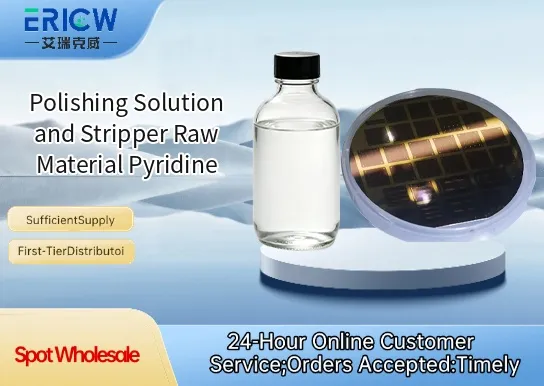
High-purity pyridine (≥99.5%) ensuring consistent performance in precision polishing and stripping formulations.
Excellent solvency for resins, photoresists, and organic coatings without aggressive corrosion to stainless steel or aluminum equipment.
Low water content (<0.1%) minimizes hydrolysis risk in moisture-sensitive stripping processes.
Volatile yet controllable evaporation profile supports rapid residue removal and short process cycle times.
Stabilized formulation with trace inhibitor to prevent peroxide formation during storage and handling.
Key co-solvent in semiconductor wafer post-CMP (Chemical Mechanical Polishing) cleaning solutions.
Active ingredient in printed circuit board (PCB) solder mask and dry film resist strippers.
Functional component in optical lens and display panel surface defect-removal formulations.
Reaction medium and catalyst modifier in specialty polymer synthesis for polishing additives.
Carrier solvent for metal chelating agents in electroplating rinse and etch-back solutions.
| Chemical Type | Heterocyclic aromatic base (C₅H₅N) |
| Product Form | Clear, colorless liquid |
| Appearance | Transparent, free from suspended matter or haze |
| Melting Point | −41.6 °C |
| Boiling Point | 115.3 °C |
| Primary Applications | Polishing solution co-solvent; photoresist and coating stripper raw material |
| Key Features | High solvating power for polar organics; low viscosity; miscible with common industrial solvents |
| Regulatory Compliance | REACH registered; compliant with OSHA Hazard Communication Standard (29 CFR 1910.1200); SDS available upon request |
| Common Compatible Systems | Suitability |
| Acidic aqueous-based stripping baths (e.g., H₂SO₄/H₂O₂ mixtures) | Recommended – Enhances dissolution kinetics without compromising bath stability |
| Alkaline amine-containing polishing slurries (e.g., NH₃/ethanolamine systems) | Highly Recommended – Improves dispersion of abrasive particles and prevents agglomeration |
| Organic solvent blends (e.g., NMP, DMSO, γ-butyrolactone) | Suitable – Fully miscible; maintains formulation homogeneity at ambient temperatures |
| Stainless steel (316 SS) and polypropylene process equipment | Highly Recommended – Non-corrosive under standard operating conditions (≤40 °C) |
Q1: What is the CAS Number for this pyridine grade?
A: The CAS Registry Number is 110-86-1. This refers specifically to anhydrous, high-purity pyridine meeting ASTM D509-22 specifications for electronic-grade solvents.
Q2: What is the recommended usage concentration in a typical resist stripper formulation?
A: Typical working concentrations range from 5–20 wt% in multi-component stripper blends. Optimal dosage depends on substrate type and resist chemistry—validation via small-scale compatibility testing is advised before full-scale implementation.
Q3: How does this pyridine differ from technical-grade pyridine in polishing applications?
A: This grade features tighter control on aldehyde impurities (<10 ppm), lower chloride content (<5 ppm), and certified absence of heavy metals (Pb, Cd, Hg <1 ppm), critical for preventing micro-defects and metallic contamination in high-precision polishing.
Q4: Is pyridine subject to migration or leaching when used in final product contact systems?
A: Pyridine is highly volatile (vapor pressure: 2.3 kPa at 20 °C) and not intended for use in final consumer-facing products. It fully evaporates during standard post-strip bake steps (>80 °C); residual levels in finished devices are below detectable limits (<0.1 ppm) per ICP-MS analysis.
Contact With Us:
E-mail: wangxingqiang@ericwchem.com
Have a Questions? Call Us:
Add:
Building A1, Jiete Industrial Park, Huangpu District, Guangzhou City, Guangdong Province, China