English
 Español
 tiếng việt
 русский
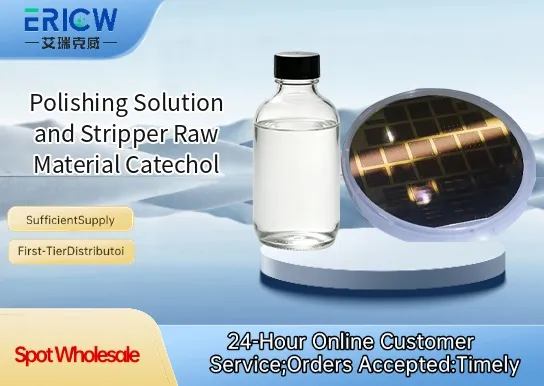
High-purity crystalline catechol (≥99.5%) ensures consistent reactivity in precision polishing and stripping formulations.
Excellent reducing and chelating properties enhance metal oxide dissolution and surface passivation performance.
Thermally stable under standard formulation processing conditions (up to 80 °C), supporting robust batch manufacturing.
Low volatility and controlled solubility in polar solvents enable safe handling and predictable formulation integration.
Non-halogenated, sulfur-free molecular structure supports environmentally responsible chemical process design.
Copper and copper-alloy CMP (Chemical Mechanical Planarization) slurries for semiconductor interconnect processing.
Photoresist and organic polymer stripping solutions in advanced microelectronics fabrication.
Specialty metal surface conditioning agents for high-precision optical and MEMS components.
Stabilizer and co-reductant in electroless plating bath formulations.
Intermediate in synthesis of high-performance corrosion inhibitors for aerospace fluid systems.
| Chemical Type | Organic aromatic dihydroxybenzene (1,2-benzenediol) |
| Product Form | White to off-white crystalline powder |
| Appearance | Free-flowing crystals; no visible discoloration or clumping |
| Melting Point | 104–106 °C (ASTM D87) |
| Purity (GC) | ≥99.5% (main peak area) |
| Moisture Content (Karl Fischer) | ≤0.15% w/w |
| Residue on Ignition | ≤0.05% w/w |
| Regulatory Compliance | REACH registered; compliant with EU RoHS 3 Annex II (excl. exemptions); SDS available per GHS Rev. 10 |
| Common Compatible Systems | Suitability |
| Aqueous alkaline H₂O₂-based polishing slurries | Highly Recommended – Synergistic oxidation control and particle dispersion stability |
| Organic solvent-based resist strippers (e.g., NMP, GBL, DMSO blends) | Recommended – Good solubility and thermal compatibility up to 75 °C |
| Chelated metal ion removal solutions (e.g., citrate/EDTA hybrids) | Suitable – Effective co-chelator for Cu²⁺, Fe³⁺, and Ni²⁺ without precipitation |
| Low-pH acidic cleaning formulations (pH 2–4) | Suitable – Stable under short-term exposure; avoid prolonged contact below pH 1.5 |
Q1: What is the CAS Registry Number for catechol used in polishing and stripping applications?
A: The CAS Number is 120-80-9. This applies to all high-purity catechol grades meeting ≥99.5% purity specifications.
Q2: What is the typical usage concentration range in copper CMP slurries?
A: Standard loading is 0.05–0.3 wt% relative to total slurry mass, optimized based on oxidizer type, pH, and desired removal rate uniformity.
Q3: How does catechol compare to hydroquinone or resorcinol in stripping performance?
A: Catechol offers superior chelation kinetics for transition metals and faster redox initiation at neutral-to-alkaline pH versus hydroquinone; it provides higher selectivity than resorcinol in multi-layer film stripping.
Q4: Is catechol subject to migration or leaching concerns in final device packaging?
A: When fully consumed in formulated reactions (e.g., as a sacrificial reductant), residual catechol is negligible; validated wipe tests show <0.1 ppm on wafer surfaces post-rinse (per SEMI F57).
Q5: Does this material carry any food-contact or pharmaceutical-grade certifications?
A: No — this grade is designated for industrial electronic and specialty chemical use only; it is not certified to USP, EP, or FDA 21 CFR 170–189 requirements.
Contact With Us:
E-mail: wangxingqiang@ericwchem.com
Have a Questions? Call Us:
Add:
Building A1, Jiete Industrial Park, Huangpu District, Guangzhou City, Guangdong Province, China