English
 Español
 tiếng việt
 русский
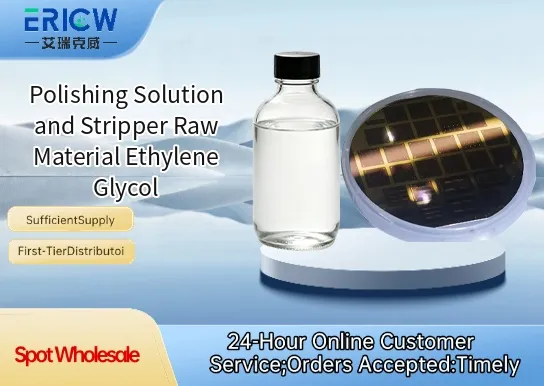
High-purity ethylene glycol (≥99.9% assay) ensures consistent performance in precision polishing and stripping formulations.
Low volatility and high boiling point (197 °C) enable stable operation in elevated-temperature industrial processes.
Excellent solvency for resins, photoresists, and organic contaminants without aggressive corrosion to stainless steel or aluminum equipment.
Hydrophilic nature supports effective water-miscibility and uniform dispersion in aqueous-based polishing and stripping blends.
Non-volatile residue-free evaporation profile minimizes post-process cleaning requirements and surface contamination risks.
Key co-solvent in CMP (Chemical Mechanical Planarization) slurries for semiconductor wafer polishing.
Active carrier and viscosity modifier in photoresist strippers for flat panel display (FPD) and OLED manufacturing.
Stabilizing agent in metal surface preparation solutions for aerospace component finishing and anodizing pretreatment.
Performance enhancer in industrial-grade paint and coating removers for precision electronics enclosures.
Reaction medium and heat-transfer component in specialty polymer synthesis for optical-grade polishing additives.
| Chemical Type | Diol (1,2-ethanediol) |
| Product Form | Clear, colorless liquid |
| Appearance | Transparent, free of suspended matter and haze |
| Melting Point | –13 °C |
| Boiling Point (at 760 mmHg) | 197 °C |
| Primary Applications | Polishing solution co-solvent, stripping formulation carrier, viscosity regulator |
| Key Features | High purity, low aldehyde content, low conductivity (<5 µS/cm, 25 °C, 10% w/w aqueous) |
| Regulatory Compliance | REACH registered; compliant with ISO 9001 manufacturing controls; non-RCRA hazardous per US EPA (40 CFR 261) |
| Common Compatible Systems | Suitability |
| Aqueous alkaline stripper systems (e.g., NaOH + amine blends) | Highly Recommended – Enhances solubilization of crosslinked resists without phase separation |
| CMP slurry delivery systems (polymer-stabilized colloidal silica) | Highly Recommended – Improves particle dispersion stability and pH buffering capacity |
| Stainless steel recirculation loops (316 SS) | Highly Recommended – Non-corrosive under standard operating conditions (pH 6–10, <80 °C) |
| Plastic-lined chemical storage tanks (HDPE, PP) | Recommended – Compatible; avoid prolonged contact with polycarbonate or ABS |
Q1: What is the CAS number for this ethylene glycol grade?
A: The CAS Registry Number is 107-21-1. This refers specifically to high-purity, monoethylene glycol meeting ASTM D1096 and SEMI C37 specifications.
Q2: What is the typical recommended dosage when formulating a semiconductor photoresist stripper?
A: Dosage ranges from 5–15% w/w in final formulated strippers, depending on resist type and process temperature; optimization via lab-scale compatibility testing is strongly advised.
Q3: How does this ethylene glycol differ from technical-grade material in stripping applications?
A: This grade features ultra-low aldehyde (<10 ppm), chloride (<1 ppm), and heavy metal impurities—critical to prevent micro-roughness, residue formation, or catalytic degradation of sensitive resist layers.
Q4: Is this material suitable for use in medical device cleaning validation studies?
A: Yes—it meets USP <841> and EP 2.2.47 requirements for residual solvent testing; extractables profiling data (per USP <1663>) is available upon request for Class II/III device manufacturers.
Contact With Us:
E-mail: wangxingqiang@ericwchem.com
Have a Questions? Call Us:
Add:
Building A1, Jiete Industrial Park, Huangpu District, Guangzhou City, Guangdong Province, China