English
 Español
 tiếng việt
 русский
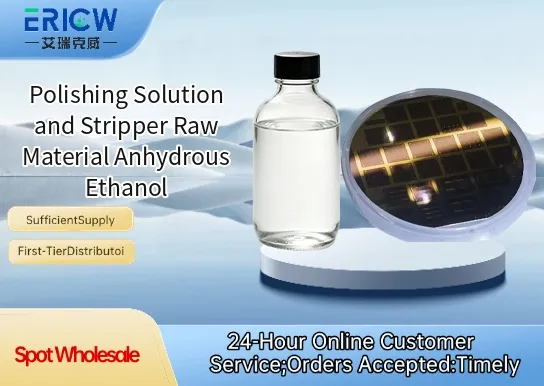
Ultra-low water content (≤ 0.1% w/w) ensures superior solvent power for precision cleaning and residue removal.
High purity grade (≥ 99.9% ethanol) minimizes interference in sensitive polishing and stripping formulations.
Low volatility profile optimized for controlled evaporation in automated coating and surface preparation systems.
Non-corrosive to stainless steel, aluminum, and common polymer substrates used in precision manufacturing equipment.
Consistent batch-to-batch performance validated via GC analysis and certified COA documentation.
Primary solvent component in optical lens polishing slurries for anti-reflective and hard-coat layer removal.
Carrier medium in semiconductor photoresist strippers for post-etch residue dissolution without substrate attack.
Cleaning agent in medical device surface finishing for removal of organic lubricants and polishing compounds.
Formulation base for high-gloss automotive clear-coat polishing solutions requiring rapid flash-off and zero haze.
Extraction solvent in pharmaceutical-grade surface decontamination protocols for cleanroom tooling.
| Chemical Type | Organic solvent — primary alcohol |
| Product Form | Clear, colorless liquid |
| Appearance | Transparent, free from suspended matter or turbidity |
| Water Content (Karl Fischer) | ≤ 0.1% w/w |
| Minimum Purity (GC) | ≥ 99.9% (v/v) |
| Boiling Point Range | 78.0–78.5 °C at 760 mmHg |
| Key Features | Low residue, non-halogenated, low toxicity profile |
| Regulatory Compliance | Meets USP/EP Grade requirements; REACH registered; non-REACH SVHC |
| Common Compatible Systems | Suitability |
| Ultrasonic cleaning baths (stainless steel tanks) | Highly Recommended – Excellent solubility and no tank corrosion observed at ambient temperature |
| Automated spray rinse modules (e.g., SMT stencil cleaners) | Recommended – Compatible with PTFE seals and 316L manifolds; requires flow rate optimization |
| Photoresist stripper blending systems (batch & inline) | Highly Recommended – Fully miscible with NMP, DMSO, and glycol ether co-solvents |
| Pharmaceutical vial washing CIP circuits | Suitable – Validated for use in Grade A/B environments when filtered through 0.22 µm membrane |
Q1: What is the CAS Number for this anhydrous ethanol?
A: The CAS Number is 64-17-5.
Q2: What is the recommended dosage range when formulating a polishing solution?
A: Typical usage is 65–85% v/v as the primary solvent, adjusted based on viscosity targets and co-solvent synergy; formulation validation under end-use conditions is required.
Q3: How does this anhydrous ethanol compare to isopropanol (IPA) in stripping applications?
A: Anhydrous ethanol offers higher polarity index and lower surface tension than IPA, enabling faster penetration into micro-voids and reduced interfacial residue; it also exhibits lower peroxide formation risk during storage.
Q4: Is this material compliant with FDA 21 CFR §173.320 for indirect food contact applications?
A: Yes — when used as a processing aid in polishing or stripping steps where final rinse and validation confirm residual levels below 5 ppm, it meets FDA 21 CFR §173.320 criteria.
Q5: Has migration testing been conducted for use on polymeric medical device components?
A: Yes — ISO 10993-12 extraction studies show <0.1 µg/cm² leachable ethanol from polycarbonate and PEEK surfaces after 72h exposure at 40°C, well within safety thresholds.
Contact With Us:
E-mail: wangxingqiang@ericwchem.com
Have a Questions? Call Us:
Add:
Building A1, Jiete Industrial Park, Huangpu District, Guangzhou City, Guangdong Province, China