English
 Español
 tiếng việt
 русский
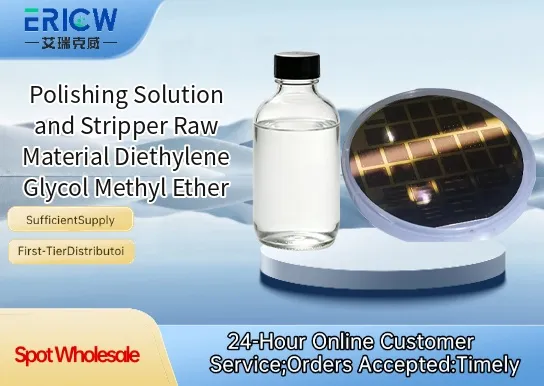
High solvency power for resins, lacquers, and photoresist residues without aggressive corrosion to aluminum or stainless steel substrates.
Low volatility (boiling point ~195°C) enabling extended bath life and reduced evaporation loss in industrial cleaning processes.
Excellent water-miscibility facilitating formulation of aqueous-based polishing solutions and eco-friendlier strippers.
Low surface tension and high wetting capability ensure uniform coverage on complex geometries and micro-patterned surfaces.
Stable under typical storage conditions with minimal peroxide formation risk compared to other glycol ethers.
Semiconductor wafer post-etch residue removal and photoresist stripping in front-end-of-line (FEOL) processes.
Optical lens and precision optics cleaning prior to coating or assembly to eliminate organic contaminants.
Electroplating line maintenance: removal of masking lacquers and polymer-based temporary coatings from metal parts.
Microelectronics packaging: cleaning flux residues and underfill adhesives from PCB assemblies and leadframes.
Automotive trim reconditioning: solvent component in non-abrasive plastic polish formulations for acrylic and polycarbonate surfaces.
| Chemical Name | Diethylene glycol monomethyl ether |
| CAS Number | 111-77-3 |
| Molecular Formula | C₅H₁₂O₃ |
| Appearance | Clear, colorless liquid |
| Odor | Characteristic mild ether-like odor |
| Density (20°C) | 0.934–0.938 g/cm³ |
| Refractive Index (20°C) | 1.412–1.416 |
| Water Solubility | Completely miscible |
| Common Compatible Systems | Suitability |
| Aqueous alkaline cleaner blends (pH 9–12) | Highly Recommended – Enhances saponification of ester-based residues without phase separation. |
| Non-ionic surfactant systems (e.g., alcohol ethoxylates) | Highly Recommended – Improves micellar solubilization and stabilizes emulsions. |
| Acidic metal passivation baths (e.g., nitric/phosphoric mixtures) | Recommended – Limited use at <5% v/v; avoid prolonged contact with hot concentrated acids. |
| UV-curable acrylate resins | Suitable – Effective co-solvent for viscosity reduction; non-reactive under ambient conditions. |
Q1: What is the CAS number and regulatory status of this material?
A: CAS No. 111-77-3; compliant with REACH Annex XIV sunset provisions (excluded), listed on TSCA Inventory, and not classified as a VOC under US EPA Method 24 (exempt compound).
Q2: Is diethylene glycol methyl ether suitable for food-contact equipment cleaning formulations?
A: Not approved for direct food-contact applications under FDA 21 CFR §173.370; may be used in closed-loop industrial cleaning where no residual migration is validated and final rinse meets NSF/ANSI 61 requirements.
Q3: How does it compare to propylene glycol methyl ether (PGME) in stripping performance?
A: DGME offers higher boiling point and stronger hydrogen-bonding capacity than PGME, resulting in superior swelling of crosslinked epoxy and polyimide films — especially effective in low-temperature stripping cycles where PGME may volatilize prematurely.
Q4: Does DGME exhibit leaching or extractables concerns in medical device manufacturing?
A: When fully removed via validated IPA/water rinses and drying, residual DGME levels fall below ISO 10993-12 extraction thresholds (<1 ppm); however, it is not recommended for final rinse of implantables without full biocompatibility requalification.
Contact With Us:
E-mail: wangxingqiang@ericwchem.com
Have a Questions? Call Us:
Add:
Building A1, Jiete Industrial Park, Huangpu District, Guangzhou City, Guangdong Province, China