English
 Español
 tiếng việt
 русский
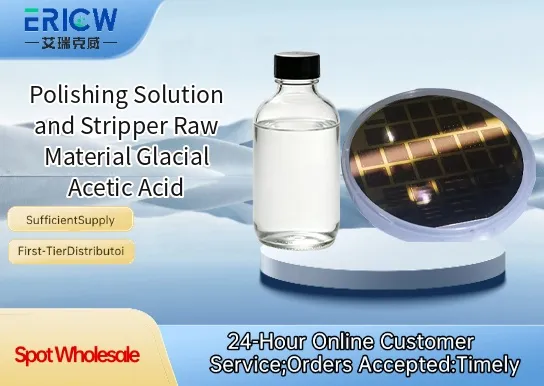
Ultra-high purity (≥99.8% assay) ensures consistent performance in precision polishing and stripping formulations.
Low water content (<0.1%) minimizes side reactions and improves shelf stability in anhydrous chemical systems.
Controlled trace metal profile (Fe < 1 ppm, Cu < 0.5 ppm) prevents catalytic degradation and surface discoloration on sensitive substrates.
Batch-to-batch reproducibility certified via GC and titrimetric analysis per ASTM E260 and ISO 6353-2 standards.
Non-volatile residue < 50 ppm supports clean post-process rinsing and reduces particulate contamination risk.
Primary acid component in semiconductor CMP (Chemical Mechanical Planarization) slurry formulations for oxide and metal layer removal.
Key pH modulator and complexing agent in electroplating strippers for copper, nickel, and chromium deposits.
Reaction medium and catalyst in synthesis of high-purity acetate-based polishing additives (e.g., ammonium acetate, glycol acetate derivatives).
Co-solvent in photoresist stripper concentrates to enhance solvation power without swelling or etching underlying layers.
Critical raw material for manufacturing ultra-low-sodium acetate buffers used in pharmaceutical-grade surface cleaning agents.
| Chemical Type | Anhydrous carboxylic acid (ethanoic acid) |
| Product Form | Liquid at room temperature (25°C) |
| Appearance | Clear, colorless liquid with characteristic pungent odor |
| Melting Point | 16.6°C (forms ice-like crystals below this temperature) |
| Boiling Point | 117.9°C at 760 mmHg |
| Density | 1.049 g/cm³ at 25°C |
| Assay (by GC) | ≥99.8% (w/w) |
| Water Content (KF) | ≤0.08% (w/w) |
| Common Compatible Systems | Suitability |
| Aqueous amine-based stripper blends (e.g., monoethanolamine + acetic acid) | Highly Recommended – Enables synergistic hydrolysis of esterified resins without aggressive corrosion |
| CMP slurries containing colloidal silica or alumina abrasives | Highly Recommended – Stabilizes dispersion pH between 4.0–5.5; prevents abrasive agglomeration |
| Organic solvent systems (e.g., PGMEA, DMSO, NMP) | Recommended – Miscible in all proportions; enhances solubility of polar organic additives |
| Stainless steel (316L) and HDPE process equipment | Suitable – Non-oxidizing at ambient temperatures; compatible with standard chemical handling infrastructure |
Q1: What is the CAS Registry Number for this grade of glacial acetic acid?
A: The CAS number is 64-19-7. This product is manufactured and tested to meet ACS Reagent Grade and ISO 9001-certified production requirements.
Q2: What is the recommended usage concentration when formulating a copper stripper?
A: For most alkaline copper strippers, use 5–15% (v/v) glacial acetic acid as a pH buffer and complexation enhancer—always validate via compatibility testing with specific chelants (e.g., EDTA, glycine) and substrate stack.
Q3: How does this grade differ from technical-grade glacial acetic acid in polishing applications?
A: This grade features significantly lower chloride (<1 ppm), sulfate (<2 ppm), and heavy metal impurities—critical to prevent micro-pitting on polished silicon wafers and avoid halide-induced stress corrosion cracking in stainless tooling.
Q4: Is this material compliant with REACH and RoHS directives for electronics manufacturing?
A: Yes—fully compliant with EU REACH (SVHC-free declaration available) and RoHS 2011/65/EU. No restricted substances above threshold limits; full documentation provided with CoA and SDS.
Q5: Does glacial acetic acid migrate or extract into polymer substrates during polishing contact?
A: Minimal migration occurs under typical short-duration (<5 min), room-temperature contact conditions. However, prolonged exposure (>30 min) at elevated temperatures (>40°C) may cause slight plasticization in acetate-sensitive polymers (e.g., cellulose acetate); compatibility testing is advised.
Contact With Us:
E-mail: wangxingqiang@ericwchem.com
Have a Questions? Call Us:
Add:
Building A1, Jiete Industrial Park, Huangpu District, Guangzhou City, Guangdong Province, China