English
 Español
 tiếng việt
 русский
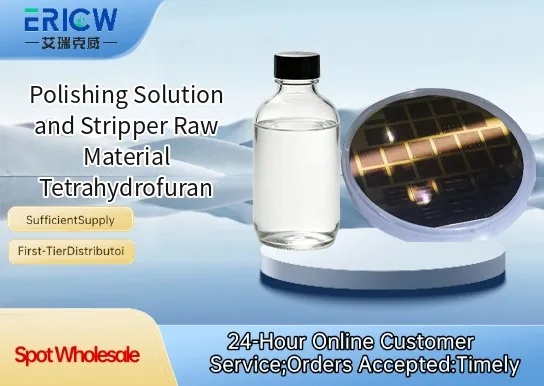
High-purity grade (≥99.9%) optimized for precision polishing and photoresist stripping processes.
Low water content (<50 ppm) ensures consistent solvent performance and minimizes hydrolysis side reactions.
Controlled peroxide formation inhibitors (e.g., BHT) included to enhance shelf life and handling safety.
Excellent solvency for polymeric resins, epoxy-based coatings, and acrylic adhesives without substrate swelling.
Volatile yet controllable evaporation rate—enables rapid residue removal while supporting process repeatability.
Primary raw material in semiconductor wafer cleaning formulations for post-CMP (Chemical Mechanical Polishing) residue removal.
Key solvent component in advanced photoresist strippers for LCD, OLED, and microLED display manufacturing.
Carrier medium in precision optical lens polishing solutions for anti-reflective and hard-coat layer dissolution.
Processing aid in flexible printed circuit board (FPCB) fabrication for solder mask and coverlay removal.
Reaction medium in specialty polymer synthesis where aprotic, mid-polarity solvation is required.
| Chemical Type | Cyclic ether, aprotic solvent |
| Product Form | Clear, colorless liquid |
| Appearance | Transparent, free of suspended matter or haze |
| Melting Point | −108.4 °C |
| Boiling Point (at 760 mmHg) | 66 °C |
| Density (20 °C) | 0.889 g/cm³ |
| Water Content (Karl Fischer) | ≤50 ppm |
| Residue on Evaporation | ≤10 ppm |
| Common Compatible Systems | Suitability |
| Acid-based resist strippers (e.g., H₂SO₄/H₂O₂ mixtures) | Highly Recommended – Acts as co-solvent to improve organic phase miscibility and penetration. |
| Alkaline metal-ion-free cleaning systems | Recommended – Compatible with low-metal NaOH/ethanolamine blends; no saponification risk. |
| Ultrasonic immersion cleaning equipment (stainless steel & PTFE-lined tanks) | Highly Recommended – Non-corrosive to common wet bench materials under controlled conditions. |
| Spin-rinse developers (SRDs) with N₂ purge capability | Suitable – Low surface tension and rapid volatility support uniform drying without watermarking. |
Q1: What is the CAS Registry Number for THF used in polishing and stripping formulations?
A: The CAS number is 109-99-9. Our grade complies with ACS Reagent and ISO 8573-1 purity benchmarks for critical process applications.
Q2: What is the recommended usage concentration when formulating a photoresist stripper?
A: Typically blended at 15–40 wt% in proprietary solvent mixtures; exact ratio depends on resist chemistry and process temperature—validation via DOE testing is advised.
Q3: How does THF compare to NMP or DMF in stripping efficiency and safety profile?
A: THF offers faster evaporation and lower toxicity vs. NMP/DMF, but requires stricter peroxide monitoring; it delivers superior lift for acrylate-based resists while avoiding reproductive hazard classifications.
Q4: Is this THF compliant with REACH, RoHS, and USP Class 3 residual solvent limits?
A: Yes—certified REACH SVHC-free, RoHS-compliant (exempted substance), and meets ICH Q3C Class 3 limits (5000 ppm) for pharmaceutical-grade intermediates and medical device cleaning agents.
Q5: Does THF exhibit extractable migration into polymer substrates during high-temp stripping cycles?
A: Minimal migration occurs below 70 °C; above this threshold, transient absorption may occur in amorphous polymers (e.g., PC, ABS)—post-process thermal desorption or N₂ bake-out is recommended for critical optics or implantable device components.
Contact With Us:
E-mail: wangxingqiang@ericwchem.com
Have a Questions? Call Us:
Add:
Building A1, Jiete Industrial Park, Huangpu District, Guangzhou City, Guangdong Province, China