English
 Español
 tiếng việt
 русский
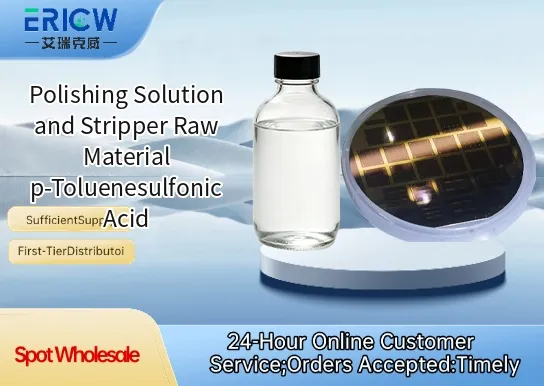
Highly effective catalytic acidity for controlled esterification and condensation reactions in polishing and stripping formulations.
Excellent solubility in common organic solvents (e.g., alcohols, ketones, glycol ethers), enabling uniform integration into multi-component systems.
Thermally stable up to 150 °C, supporting high-temperature processing without premature decomposition or volatility loss.
Low hygroscopicity ensures consistent performance and shelf-life stability under ambient storage conditions.
Non-oxidizing nature minimizes risk of substrate discoloration or unintended side reactions during surface treatment.
Acid catalyst in metal polishing solutions for copper, aluminum, and stainless steel surface refinement.
Active component in photoresist and conformal coating strippers for semiconductor and PCB manufacturing.
Reaction promoter in solvent-based acrylic and polyester resin systems used in industrial finishing coatings.
Hydrolysis accelerator in urethane-based stripping agents targeting epoxy and polyurea floor coatings.
Co-catalyst in silicone release coating formulations for precision polishing pads and abrasive backing materials.
| Chemical Type | Aromatic sulfonic acid |
| CAS Number | 104-15-4 |
| Product Form | White crystalline powder or monohydrate crystals |
| Appearance | Free-flowing white to off-white crystalline solid |
| Melting Point | 106–107 °C (anhydrous); 103–105 °C (monohydrate) |
| Primary Applications | Catalyst in polishing formulations, stripping agent synthesis, resin crosslinking |
| Key Features | Strong Brønsted acidity (pKa ≈ −2.8), low volatility, high thermal stability |
| Regulatory Compliance | REACH registered; compliant with EU Directive 2004/42/EC for VOC-exempt classification when used as catalyst |
| Common Compatible Systems | Suitability |
| Isopropanol / Methyl Ethyl Ketone (MEK) blends | Highly Recommended – Ensures full dissolution and catalytic homogeneity |
| Glycol ether-based stripping matrices (e.g., DPnB, DPGME) | Recommended – Provides balanced evaporation rate and acid dispersion |
| Water-miscible co-solvent systems (e.g., NMP/water mixtures) | Suitable – Requires pH stabilization and temperature control below 60 °C |
| Acrylic emulsion polishing carriers | Suitable – Effective only with pre-neutralized or buffered formulations to prevent coagulation |
Q1: What is the CAS number for p-toluenesulfonic acid used in polishing and stripping formulations?
A: The CAS Registry Number is 104-15-4 for the anhydrous form and 6192-52-5 for the monohydrate form — both are widely accepted in industrial formulations per supplier specifications.
Q2: What is the typical recommended dosage range when using p-toluenesulfonic acid as a catalyst in polishing solutions?
A: Dosage typically ranges from 0.2 wt% to 1.5 wt% relative to total formulation mass; optimal concentration depends on resin type, temperature profile, and required reaction kinetics — always validate via small-batch compatibility testing.
Q3: How does p-toluenesulfonic acid compare to hydrochloric acid or sulfuric acid in stripping applications?
A: Unlike mineral acids, p-toluenesulfonic acid offers superior selectivity, lower corrosion potential toward metals and equipment, negligible fuming, and easier handling in non-aqueous systems — making it preferred for precision electronics and optical surface treatments.
Q4: Is p-toluenesulfonic acid subject to migration or leaching concerns in finished polished surfaces?
A: When fully reacted and thermally cured (e.g., in crosslinked resin matrices), residual acid content is negligible; unreacted traces may migrate in humid environments — hence post-treatment neutralization or rinsing is advised for critical end-use applications.
Q5: Does this material meet RoHS or REACH SVHC requirements for electronics-grade polishing agents?
A: Yes — p-toluenesulfonic acid (CAS 104-15-4) is not listed on the REACH SVHC Candidate List nor restricted under RoHS Annex II; full regulatory documentation and SDS are available upon request for qualified industrial users.
Contact With Us:
E-mail: wangxingqiang@ericwchem.com
Have a Questions? Call Us:
Add:
Building A1, Jiete Industrial Park, Huangpu District, Guangzhou City, Guangdong Province, China