English
 Español
 tiếng việt
 русский
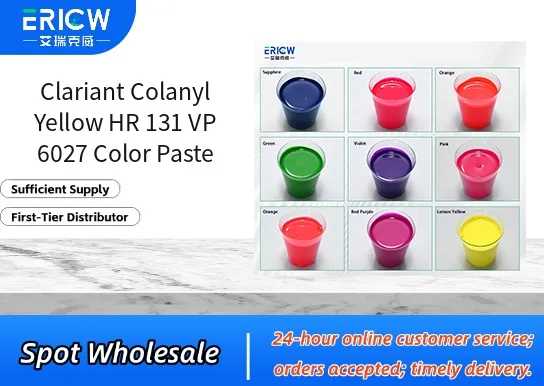
High chroma yellow shade with excellent lightfastness and weather resistance.
Optimized for low VOC and solvent-free formulations in modern industrial coatings.
Excellent dispersion stability in water-based and high-solids acrylic systems.
Good compatibility with common resins including polyurethanes, epoxies, and alkyds.
Consistent batch-to-batch color reproducibility supported by Clariant’s stringent QC protocols.
Automotive refinish coatings (basecoat and clearcoat systems).
Industrial maintenance coatings for machinery and metal structures.
Architectural wall paints and façade coatings requiring durable yellow tones.
Plastic coloration for exterior automotive components (e.g., trim, grilles).
Wood coatings for outdoor furniture and decking applications.
| Chemical Type | Azo pigment dispersion (organic) |
| Product Form | Liquid color paste (aqueous-based) |
| Appearance | Homogeneous yellow paste, free of grit or sediment |
| Primary Applications | Water-based and solvent-borne industrial coatings, automotive refinish |
| Key Features | Lightfastness ≥ 7 (ISO 105-B02), weather resistance per ISO 11341 |
| Benefits | Reduced formulation complexity, improved tinting strength vs. dry pigments |
| Storage Stability | 12 months at 5–30 °C in sealed original container |
| VOC Content | < 50 g/L (per EU Directive 2004/42/EC) |
Q1: What is the primary application field for Colanyl Yellow HR 131 VP 6027?
A: This high-performance yellow color paste is primarily developed for coloring polyolefin-based packaging materials, including flexible films and rigid containers, where excellent heat stability and dispersion are required during extrusion or injection molding.
Q2: Is this product suitable for food-contact applications?
A: Colanyl Yellow HR 131 VP 6027 is formulated to meet common regulatory expectations for food-contact plastics in major markets; however, final compliance depends on the complete formulation, processing conditions, and applicable local regulations — users must conduct their own due diligence and validation.
Q3: How should this color paste be incorporated into polyolefin compounds?
A: It is typically introduced via masterbatch dilution or direct addition during compounding, with optimal results achieved using standard high-shear mixing equipment. Pre-drying is not required, but good dispersion practices—such as adequate melt temperature and residence time—are recommended.
Q4: What are the key handling and storage recommendations?
A: Store in original sealed containers at temperatures between 5 °C and 30 °C, away from direct sunlight and sources of heat. Avoid freezing, and ensure lids are tightly closed after each use to prevent skin formation and moisture uptake.
Contact With Us:
E-mail: wangxingqiang@ericwchem.com
Have a Questions? Call Us:
Add:
Building A1, Jiete Industrial Park, Huangpu District, Guangzhou City, Guangdong Province, China