English
 Español
 tiếng việt
 русский
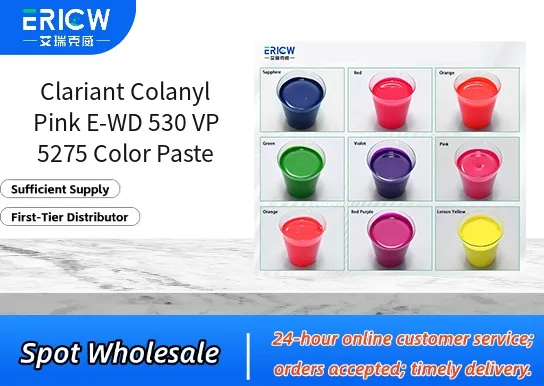
High chroma, clean pink shade with excellent batch-to-batch color consistency.
Water-based formulation designed for low VOC and improved workplace safety.
Optimized dispersion stability for extended shelf life and minimal settling in storage.
Excellent compatibility with common waterborne acrylic, PUD, and styrene-acrylic binder systems.
Good lightfastness and thermal stability suitable for ambient and moderate-temperature processing.
Architectural and decorative waterborne interior wall paints.
Water-based industrial maintenance coatings for metal and wood substrates.
Low-VOC furniture and cabinetry finishes.
Waterborne coil coatings requiring consistent pastel pink hues.
DIY and professional-grade water-based primers and undercoats.
| Chemical Type | Organic pigment dispersion (quinacridone-based) |
| Product Form | Liquid color paste |
| Appearance | Viscous, homogeneous pink liquid |
| Primary Applications | Waterborne architectural and industrial coatings |
| Key Features | Water-based, non-ionic stabilization, low heavy metals |
| Benefits | Easy incorporation, low foaming, high tinctorial strength |
| pH Range | 7.5 – 8.5 |
| Storage Temperature | 5 – 30 °C (avoid freezing) |
Q1: What types of water-based systems is Colanyl Pink E-WD 530 VP 5275 specifically formulated for?
A: This color paste is engineered for use in aqueous industrial coatings, including waterborne architectural paints, wood finishes, and general-purpose protective coatings where stable pink-to-red shading with good tinctorial strength and dispersion stability is required.
Q2: How does the paste perform under typical storage and processing conditions?
A: Colanyl Pink E-WD 530 VP 5275 exhibits good shelf stability in sealed containers at ambient temperatures and maintains dispersion integrity during moderate shear mixing. It is not recommended for prolonged exposure to freezing or elevated temperatures above 40 °C without prior compatibility testing.
Q3: Is this product compatible with common co-binders and additives used in water-based formulations?
A: Yes — it demonstrates broad compatibility with acrylic, vinyl acetate, styrene-acrylic, and polyurethane dispersions, as well as typical rheology modifiers, defoamers, and biocides. However, compatibility should always be verified in the final formulation due to system-specific interactions.
Q4: What is the recommended dosage range for achieving target shade intensity?
A: Dosage depends on the base formulation opacity, desired shade depth, and pigment loading requirements, but it is typically used at low concentrations — generally ranging from 0.1% to 2% by weight relative to the total formulation — to achieve consistent, reproducible pink hues.
Contact With Us:
E-mail: wangxingqiang@ericwchem.com
Have a Questions? Call Us:
Add:
Building A1, Jiete Industrial Park, Huangpu District, Guangzhou City, Guangdong Province, China