English
 Español
 tiếng việt
 русский
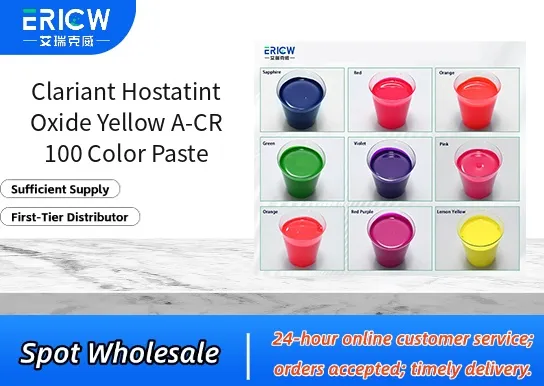
High chroma, consistent oxide yellow hue with excellent batch-to-batch color reproducibility.
Optimized rheology for easy dispersion in water-based and solvent-based systems without additional grinding.
Excellent lightfastness and thermal stability up to 180 °C, suitable for demanding processing conditions.
Low volatile organic compound (VOC) content, supporting sustainable formulation requirements.
Compliant with major global regulatory frameworks including REACH and RoHS for restricted substances.
Architectural and industrial waterborne coatings.
Plastic coloration for polyolefins (PP, PE) and PVC compounds.
Printing inks for flexible packaging and label applications.
Construction materials including cementitious renders and tile adhesives.
Wood stains and transparent decorative coatings requiring high transparency and UV resistance.
| Chemical Type | Inorganic iron oxide pigment dispersion |
| Product Form | Concentrated liquid color paste |
| Appearance | Viscous, homogeneous yellow paste |
| Primary Applications | Coatings, plastics, inks, construction materials |
| Key Features | Easy dispersion, high opacity, low VOC, heat stable |
| Recommended Carrier | Water and glycol-modified aliphatic hydrocarbon solvents |
| pH (10% aqueous dilution) | 7.5 – 8.5 |
| Storage Stability | 12 months at 5–30 °C in sealed original container |
Q1: What is the primary application field for Hostatint Oxide Yellow A-CR 100?
A: This color paste is specifically developed for coloring polyolefin-based plastics—especially PP and HDPE—in applications requiring excellent thermal stability, good dispersion, and consistent hue under processing conditions such as injection molding and extrusion.
Q2: Is this product suitable for food-contact plastic applications?
A: Hostatint Oxide Yellow A-CR 100 is formulated with inorganic oxide pigments and is designed to meet general regulatory expectations for indirect food contact applications in polyolefins; however, final compliance depends on the complete formulation, processing parameters, and applicable regional regulations—users must conduct their own due diligence and verification.
Q3: How should this color paste be incorporated into polymer melts?
A: It is typically introduced via gravimetric or volumetric dosing directly into the feed throat of an extruder or injection molder, or pre-blended with base resin using a high-shear mixer. Good dispersion is achieved at standard processing temperatures for polyolefins without requiring additional dispersing aids.
Q4: What are the key handling and storage recommendations?
A: Store in original sealed containers at temperatures between 5 °C and 30 °C, away from direct sunlight and moisture. Avoid freezing. Stir gently before use if phase separation occurs during prolonged storage, as this paste contains a non-volatile carrier system optimized for polymer compatibility.
Contact With Us:
E-mail: wangxingqiang@ericwchem.com
Have a Questions? Call Us:
Add:
Building A1, Jiete Industrial Park, Huangpu District, Guangzhou City, Guangdong Province, China