English
 Español
 tiếng việt
 русский
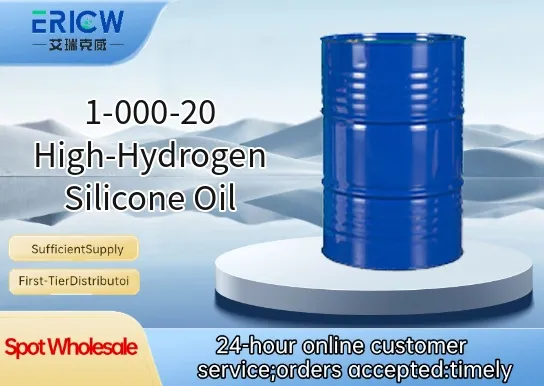
High active hydrogen content enables efficient hydrosilylation reactions with alkenes and alkynes.
Low viscosity (20–25 cSt at 25°C) ensures excellent processability and uniform dispersion in formulations.
Thermally stable up to 200°C, supporting high-temperature curing processes without premature decomposition.
Consistent molecular weight distribution ensures reproducible reactivity and crosslink density.
Compatible with platinum-based catalysts and widely used silicone polymers for seamless integration.
Hydrosilylation-curable liquid silicone rubber (LSR) systems for medical and automotive components.
Crosslinking agent in heat-cured silicone gels for electronics encapsulation and thermal interface materials.
Functional additive in silicone release coatings for paper, film, and composite manufacturing.
Reactive diluent and chain extender in specialty silicone resins for high-performance coatings.
Hydrogen donor in silicone-based adhesives and pressure-sensitive adhesive (PSA) formulations.
| Chemical Type | Methylhydrogen polysiloxane (linear) |
| Product Form | Clear, colorless liquid |
| Appearance | Transparent, mobile liquid with no visible particulates |
| Viscosity (25°C) | 20–25 cSt |
| Active Hydrogen Content | 0.85–0.95 wt% |
| Density (25°C) | 0.97–0.99 g/cm³ |
| Volatile Content (150°C, 2h) | <1.0 wt% |
| Flash Point (COC) | >180°C |
Q1: What is the primary functional role of 1-000-20 High-Hydrogen Silicone Oil in silicone elastomer formulations?
A: It serves as an efficient crosslinking agent and hydrosilylation catalyst co-reactant, enabling controlled network formation in addition-cure silicone systems—particularly where high hydrogen content supports rapid, low-temperature curing with improved mechanical integrity.
Q2: Is 1-000-20 compatible with platinum-based catalysts commonly used in medical-grade or food-contact silicone compounds?
A: Yes—it is specifically designed for compatibility with platinum catalysts and is widely employed in high-purity applications, including medical device encapsulation and food-grade elastomers, provided formulation and processing conditions are carefully controlled to avoid premature inhibition or side reactions.
Q3: How should 1-000-20 be handled and stored to maintain its reactivity and shelf life?
A: Store in tightly sealed containers under inert atmosphere (e.g., nitrogen), away from moisture, direct sunlight, and elevated temperatures. Typical shelf life is 12–18 months when stored at room temperature in original unopened packaging; exposure to ambient humidity or air may gradually reduce active Si–H functionality.
Q4: Can 1-000-20 be used in solvent-free or high-solids coating systems?
A: Yes—it is fully miscible with most silicone resins and base polymers, and is frequently incorporated into solvent-free, high-solids, or UV-assisted hybrid cure systems to enhance crosslink density and surface hardness without compromising viscosity control during application.
Contact With Us:
E-mail: wangxingqiang@ericwchem.com
Have a Questions? Call Us:
Add:
Building A1, Jiete Industrial Park, Huangpu District, Guangzhou City, Guangdong Province, China